Sunday, June 08, 2008

Southern Dalmatia

In our last blog we did a disservice to Brindisi. The town is a clean thriving town with grand stone paved boulevards full of chic shops and charming back streets and pretty squares. It has for centuries been the port of Italy that serves the Orient and in the nineteenth century the town was a link on the voyage between London and Bombay. Here Caesar engaged in a fierce sea battle with Pompeius and Antonio and Octavianus divided the Roman Empire. Two Roman columns standing tall above the town quay mark the end of the Via Appia, the Roman road from Rome.

Entertainment during our uneventful 125 mile passage to Dubrovnik was provided by many young and extremely playful common Dolphins having great fun jumping and darting to and fro under Bella. The sight of a Peregrine Falcon flying north on two separate occasions also excited us.

The excellent Italian weather forecasts broadcast on the VHF radio continuously in English now give way to very good Croatian VHF radio forecasts and Navtex forecasts from Split radio at least three times a day.

Seen on Augusta, Sicily Navtex a Navigation warning as follows:
Buoy No.204 with coordinates 43°19.8’N 017°36.8’E. Tear itself away from its place. The language of the sea is English but nothing says it has to be the Queen’s English!

Many European nations and. of course, the Tunisians could learn a lot from the Croatian authorities about how to complete entry formalities. The issue of a Vignette, or sailing permit, clearing customs and seeing the Police took less than three quarters of an hour. All we have to show at each harbour or marina from now on is our Vignette and crew list and so no lengthy form filling every time we berth. The Vignette did cost £100 but it is valid for a year!!

Dubrovnik Marina is a very posh affair charging posh prices at 45 euros a night and it is not even high season. In fact most Marinas in Croatia appear to be about this price which rises by 10% or 20% in July and August. The showers were excellent but the laundry and supermarket were not functioning and the swimming pool was not in use. The Marina is however in a superb setting in the gardens of a former Palace with high, steep tree clad slopes all around.

The earliest recorded settlement at Dubrovnik was in the seventh century AD. Since then the town has had a chequered history having been ruled by the Romans, the Venetians, Hungarians and even the French for a while. The town was at its most prosperous during the fifteenth and sixteenth centuries when it possessed the third largest fleet in the world. It has suffered destruction from, amongst other things, the earthquake of 1667 and more recently in 1991 when 2000 Serbian shells and missiles fell on the town. Much of the town now dates from the rebuilding after the earthquake and much effort and money has been spent in repairing the war damage in a remarkably short time. I had been here with my father some forty years ago but I can remember little of Dubrovnik’s magnificence. We walked the impressive city walls from whose ramparts and bastions we looked over the harbour, the stately buildings, the red pantiled roofs and the narrow stepped alleyways. We had a beer and sandwich in a cafe on the main street, Stradun, and wondered over the splendour of the place and the warmth of the atmosphere.
Our cruising ground for the spring comprises the southern and central Dalmatian Islands between Dubrovnik and Sibenik some 120 miles to the North West. The distance between the many Islands rarely exceeds 10 miles and so we are in the main well sheltered from the prevailing winds. Having said that the sea breeze can be fresh late on a summer afternoon. The dreaded ‘Bura’, an unpredictable north easterly wind, can literally fall off the mountains behind the coastal belt and blow very strongly as we found out to our chagrin whilst at anchor overnight in an exposed inlet on the tiny Otok Scedro. Still no damage done, just loss of sleep.

The Island landscape is a mixture of barren rock, maquis, forested slopes and some cultivation, particularly in the form of vineyards, all set against the backdrop of the high rocky mountains of the mainland. We have not seen animals on the Islands but the birdsong especially that of the swallow is deafening.

We would need to write a book to describe all the pleasures, places and delights of the Islands we have visited so far and thus we have mentioned just a few of our favourites in the following paragraphs
We will always remember the fresh smell of pine as we sailed into Sipanski Luka, the capital of Otok (Island) Sipan, the largest of the Elaphite Island group just north west of Dubrovnik where we spent a very pleasant night at anchor in the long, sheltered inlet. The Elaphite Islands were so named by the natural historian, Pliny the Elder, after the fallow deer he found there.

The Island of Mjlet is reputed to be one of the most enchanting in the Adriatic and where legend has it that Calypso held Odysseus for seven years. The north western end of Otok Mljet is a national park by reason of its forest of Aleppo pine and Holm oak which grow densely right down to the rocky foreshore. One would have to go a long way to find such a stunning sheltered anchorage as that in which we found ourselves where the peace was broken only by the gentle ripple of blue green water and the calls of Mongeese imported into the Island to rid it of snakes.

The lovely old town of Korcula on the Island of the same name perched as it is on a hill on a small isthmus jutting out into the Peljeski Kanal, is surrounded by 13th century walls reinforced by the Venetians with bastions and towers in the 15th century. It is an enchanting place with a fine Cathedral and other late 15th century buildings. The narrow streets were designed to lessen the effect of the Bura wind. The town was fought over by the Venetians and the Croat Kings and later by the Genoese and the Turks. In a naval battle between the Genoese and the Venetians in 1298, the Genoese captured Marco Polo who is said to be a native of the town.

The principal town on Otok Hvar, named Hvar, is an absolute delight which has been under the control of Byzantines, Romans, the Croatian-Hungarian Kingdom and the Venetians from 1278 to 1797; it was during their long rule that the principal public and sacral buildings were constructed. The Cathedral and its bell tower, the Clock Tower and Civic Loggia and the Bishop’s palace were all built during the 15th and 16th centuries and the large plain, yet handsome, Arsenal surround the town’s beautiful square on three sides, the fourth of which is open to the wonderful harbour in which we anchored. This small town has the feel of Venice and the smell of lavender which covers the Island’s hillsides in blue. We were pleased to see the cruise ship ‘Saga Ruby’ anchor in the roads just outside Hvar. It took nearly all day for her passengers to be ferried to and from her for their guided tour of the town. Liberty boats were plying back and forth endlessly.

Another town of interest on Hvar Island is Stari Grad founded in 384BC by the Greeks, or more accurately the Syracusans, with the name of Pharos. It is the oldest town in Croatia and prior to the middle of the 15th century was the capital of Hvar Island. The small old town is absolutely delightful with stone built houses, a Palace and Monastery built around large squares and narrow streets. The stonework is unusual with random coursing and flush jointing. It is reminiscent of the style we saw in Piriac sur Mer and Pornique in the French Loire-Atlantique.

Excellent quality snowy white stone has been quarried in the Islands since Roman times. Stone from Brac was used for most of the palaces and churches in Venice and for facing the White House in Washington.
The tiny hamlet of Bobovisce on Otok Brac is occupied only by the indigenous people who speak no English. Our mooring on the quay is a very refreshing, peaceful haven. There is one poorly stocked shop whose keeper has to be summoned from her house by ringing a bell, a local Bar and Restaurant on the quayside and not a church in sight. Nobody has asked us for the mooring dues so we guess that the season hasn’t started here yet.

We are so glad to be sailing in these Islands out of season of as we have moorings like this and beautiful anchorages to ourselves whereas in high season we gather things get rather crowded. However, we have been amused by the berthing spectaculars that are staged in the early evening when the sea breeze is at its strongest!

The easy pay as you go internet access from the boat via our mobile and the Italian server TIM has gone and will be replaced by rather patchy and inadequate connection in internet cafes whilst in Croatia. Please forgive, therefore, the possible infrequency of these blogs. We are publishing this blog from the first WiFi connection we have come across in Croatia in this tiny Island of Prvic just offshore from Sibenik. We will be heading North tomorrow and will publish the next episode about Central Dalmatia and the Split/Trogir area when we next have good access.

Our Croatian mobile number has changed to: +385 99 50 96 64 3

Monday, April 14, 2008

If The Shoe Fits.........

From Sicily we had decided to make passage as quickly as possible, weather permitting, to Brindisi our last port of call in Italy before crossing the Adriatic to Dubrovnik. The coast of the toe and heel of Italy is inhospitable at this time of year, particularly the Golfo di Squillace (the bay between the toe and the ball of the foot) and the Golfo di Taranto (the bay forming the instep) and ports of refuge are spaced at least a full day’s sail apart.
As we set sail from Riposto, Sicily bound for Crotone a passage of some 24 hours the sky looked evil over the Messina Straights and even more menacing as we passed Capo Spartivento, the most south westerly point of mainland Italy. Sure enough, crossing the Golfo di Squillace was, to say the least, exciting, with violent thunderstorms and 30 knot gusts. We achieved 9 knots under sail, not surfing, and an average of 8 knots for one particular hour. As we made our landfall in the morning of Neal’s 62nd birthday the wind eased and the sea calmed down, Miggy cooked bacon (from Malta) butties as a treat, and we tied up in Crotone with help from a very willing and pleasant Ormaggiatori. I was delighted to receive cards from Betsy and Beryl and I was very excited to receive from Miggy a shirt and a bottle of good brandy.
Crotone is an interesting place with a significant Greek history. The great mathematician and philosopher, Pythagoras, was the City’s best known son who founded his School of Multidisciplinary Research with its basis in Mathematics here in 530BC. It is the regional centre and has a good array of international brand shops and a busy nightlife along the shore, particularly for the young. The array of fine villas is evidence of the fact that the town was extremely wealthy. Indeed it still appears to be so despite the fact that it is a bit worn at the edges! Crotone affords little shelter from the southerly wind and the swell in the harbour makes things very uncomfortable so we decided o move on to S. Maria di Leuca today a trip of 75 miles across the Golfo di Taranto or in other words from the toe to the heel across the instep. We encountered fog in patches with visibility down to 100m and we were very grateful for the radar. There was no wind so we were under engine for the whole passage. We saw Dolphins in 2000 metres of water, of which Miggy took the best photo yet, and there were turtles large and small. S. Maria di Leuca is also an unprotected, swelly harbour and, considering the forecast of strong winds, we decided to go to Otranto the next day where the shelter was reported to be better. On passage we rounded Capo d’Otranto, the most easterly point in Italy, and crossed latitude 40 degrees N into the Adriatic Sea.
Otranto was one of Republican Rome’s leading ports for trade with the Greeks and Asia. The Normans arrived in the eleventh century but were ousted by the Turks in 1480 when all the inhabitants bar 800 were slaughtered. The survivors were promised their lives if they denounced Christianity but they refused. The bones of the martyrs are housed in the Norman Duomo which has a vast mosaic floor laid in the twelfth century by a solitary monk. The crypt with its columns has the feel of a mosque but there is no information to support this theory. A fifteenth century castle overlooking the port adds to the charm of this quaint place.
As the weather for the following day or two looked unsettled we decided to stay in Otranto for a couple of days and take a train journey inland to Lecce a town that has earned the title of ‘Florence of Baroque Art’ due to the abundance of Baroque architecture.
Characterised by rich sculptural decoration this style was possible in Lecce because of the local building material, pietra di Lecce – a soft, easily carved stone. Baroque the facades of the churches certainly are, so much so as to verge on the grotesque. The ice cream was heavenly and the train journey fun, rattling through olive groves and fields ablaze with poppies.
The approaches to the commercial port of Brindisi are festooned with power stations and oil refineries and the town has little to offer the discerning traveller!
For those planning to follow in our wake, Marina prices around the foot of Italy are extremely reasonable being in the region of £13 to £20 mid season for a 10.5 metre yacht.
We are very soon to cross to Dubrovnik and our summer cruising ground through the Islands of the Dalmatian coast to Venice and then back to winter at Lefkas in the Greek Ionian Islands..
Our Croatian Mobile Number operative from on or about the 16th April will be:
+385958382225

Friday, April 11, 2008

Aretusa and Cyclops

The frequent winter gales that howl through the Sicily Straights delaying our departure from Gozo did not too disappointed us as it gave us a chance to explore this beautiful island more extensively.
Our tour of the Island started at Ramla Bay which did not resemble the idyllic swimming beach with great rollers crashing on to its sandy strand. Along the sea road and over the cliffs to Marsalforn, past Obaijar and Xwieni Bays to the Roman saltpans that are still producing many tons of white gold every year. Onward through the towns of Ghasri, Gharb and St Lawrenz each with their picturesque main square with church, police station complete with blue light, red post box and telephone kiosk. Apart from the massive churches each of them could be a market square in any English village.
Dwerja Point and the Azure Window, a large hole in the headland, is the picture postcard image of Gozo with a tranquil Mediterranean sea reflecting the sheer limestone cliffs. Not as we saw it, however, with the furious and dramatic with azure waves their breaking tops blown to snowy white spume under the clear blue sky. Here, protected by Fungus Rock, is a bay in which we would have liked to have anchored but not today as even this near landlocked bay was a boiling cauldron of angry water.
The winding track down to the old quarry quay at Hondoq Ir-Rummien gave us breathtaking views over the Island of Comino and its idyllic Blue lagoon where we enjoyed anchoring in rather more settled weather a few days previously.
Two things, other than the magnificence of the scenery, will remain in our memories for a long time. The first is the fact that, apart from in the capital Victoria, we were virtually the only car on the roads. We are so thankful that we are here out of season! The second is the sight and smell of the multitudinous number and variety of wild flowers that are abundant in the absolutely natural grasslands.
Our sail across the Straights to Sicily was uneventful and we made our landfall at Marzamemi on the east coast, an undistinguished but friendly place. We intended our visit to Sicily to be brief and to include just the City of Siracusa and Mount Etna.
The ancient Mediterranean settlement on the Island of Ortigia, the old town of Siracusa, inhabited since the Greeks arrived in 480BC, was one of the most important of Cities of the ancient Greek world and as Cicero declared the most beautiful. It is a veritable jewel. Its Grecian history is in evidence everywhere from the Temple of Apollo and the incredible Theatre carved out of the rock hillside to the Temple of Athena now incorporated into the 18th century Duomo. It is amazing to see the Greek and the Gothic pillars side by side and as a total disparity, the intricate Baroque facade. The church of Siracusa was the first to be founded by St Peter and, after the church of Antiochia, the second to be dedicated to Christ.
The imperial Piazzas, one of which is named after Siracusa’s most famous son Archimedes, and the maze of narrow streets with their exquisite 14th and 15th century palazzos and the grand 19th and early 20th century buildings fronting the Harbour bestow upon the place the atmosphere of Venice on land. Nelson watered his fleet here from a natural spring on the harbour side in which papyrus grows and where, legend has it, Aretusa emerged from the ground having been changed into a spring by Artemis to escape her lover Alpheus.
We walked for miles to the Archaeological Park of Neapolis on the outskirts of Siracusa. The Roman amphitheatre is disappointingly small and dilapidated compared with those we have seen in Rome and Tunisia but the Greek Theatre is colossal, the biggest in the Magna Greaccia, and stunningly carved out of the rock of the hillside.
Beside the Theatre is a Quarry of magnificent proportion aptly called the ‘Latomies of Paradise’ for its lush vegetation and citrus trees. Cut into the face of the quarried rock is the huge cave of ‘The ear of Dionysius’ named so as it is shaped like an ear. The acoustics in this vast chamber are extraordinary.
One wonders how the Greeks undertook such massive tasks with such precision with the limited and minimal tools available to them.
Weather forecasts for our next passage north along the coast were conflicting with either a westerly Force 3-4 or a north westerly Force7! During our eight hour sail to Riposto we had mostly the former with Bella picked romping along in the 12 to 15 knot breeze just forward of the beam at a creditable 7 to 8 knots even though laden as she is. Under the influence of Cyclops the one eyed monster on Mount Etna however we had 180 degree wind shifts and 30 knots of wind on the nose.

What a magnificent sight this snow capped volcano is. We are so lucky to see it at all, let alone as clearly, as it is usually, particularly during the summer, swathed in cloud and haze. Yet another good reason for sailing this part of the world in the late winter and spring. The setting for the marina and town is wonderful with Etna dominating the skyline. It is a bit like being on the shores of an Alpine lake.
For the sailors amongst you looking to budget for marina prices in this area it is mid season and they have varied from £16 in Marzamemi to £28 in Siracusa and Riposto.
Our next adventure will take us to the foot of Italy and then onward to Croatia.

Sunday, March 23, 2008

Back in Europe

Rather than break our journey from Tunisia to Malta at Lampedusa in the Italian Pelegie Islands, the small weather window dictated that we sail directly from Monastir, where we have spent the winter, to Malta. The 194 mile sail across the Sicily Straight took 31 hours. We motored for all but 7 of those hours but the weather was kind and the sea slight. Our track took us within four miles of Isola Linosa, the north westernmost Island of the Pelegie chain.
A large pod of Bottlenose Dolphins came to play with us as did a Porpoise. We nearly ran over a Turtle and we saw Swallows, perhaps the first of the season, winging their way North.
At first we thought the mysterious plume of ‘smoke’ on the horizon was a steamer but ruled this out for the fact that it was intermittent and stationary. We had just about convinced ourselves that it was ash erupting from the volcano, Etna, on Sicily, despite the fact that it was over 180 miles distant, when 50 metres from us a 20 metre Fin Whale surfaced blowing a spout of water some three metres into the air. This magnificent creature swam beneath Bella and stayed with us for over an hour circling us inquisitively without, we trusted, any menace! Our night sail was perfect with just a slither of crescent moon in a jet black sky full to brimming with stars and planets winking at us like diamonds.
Dawn marked our landfall some 30 miles off Malta and Gozo and as we approached closer white flashes and smoke puffs reminiscent of Maroons and starbursts hung above the Islands as if our arrival was being greeted with fireworks. It was not so, of course, these incendiaries called ‘Petards’ are a traditional mark of the Islander’s celebrations on saints’ days, of which there are over a hundred, and on other special occasions. This day happened to be the day after the general elections and a public holiday!
We sailed through the beautiful narrow passage between Malta and the small Island of Comino to the west and then along the north coast of Malta that was trying very hard to resemble the Costa del Sol. Then between Forts St Elmo and St Angelo into the magnificent Grand Harbour with the impressive monuments of Valletta to our right and the grand buildings of the former dockyards of the ‘Three Cities’, Vittoriosa, Senglea and Conspicua to our left. One could almost taste the history of this place and smell the vile odour of battle during the two Great Sieges of 1565 and 1940-1943, for heroism and devotion in the latter of which, of course, the whole Island was awarded the George Cross.
Grand Harbour Marina lies within Dockyard Creek with elegant and now refurbished former naval buildings all around us. We are moored directly opposite the bakery building that appears large and grand for its purpose but I guess they needed a lot of bread. Lord Nelson’s representative landed on Vittoriosa in 1799 not 100 metres from our berth to govern Malta and from the same place the last British military contingent left in 1979.
The Marina was opened by Queen Elisabeth 11 in 2005. Its facilities are exemplary, the individual rooms containing shower, wash basin and WC being finer than I have seen in many a 5 star hotel, and its staff obliging, friendly and considerate.
We are not sad to have left Tunisia after our winter there although we were very well looked after by the marina staff and we have made some good friends, both English and French, during our stay. We have enjoyed exploring the Country’s wealth of history and the beauty of the Sahara. We have found it impossible, however, to accept the widespread litter, filth and decay and some of the morals of some of the populous which are very different from those to which we are used.
Each of the ‘Three Cities’ is little larger than a village. Vittoriosa, where we are moored, takes its name from the ‘Victorious’ Great Siege of 1565 and the successful final stand of the Knights of St John against the Turks in Fort St Angelo at the end of the peninsular. This fort was also the headquarters of the British Military during the siege of 1940-1943 when it received 69 direct hits. The charming, quiet atmosphere of Vittoriosa, Birghu to the locals, belies its past during the Knights occupation as a visit to the ‘courtroom’ and the cells of the ‘Inquisitors Palace’ and the place of public execution shows! In the narrow backstreets lined with fine limestone buildings with enclosed balconies reminiscent of northern Spain are situated the ‘Auberges’ or Officer’s messes of the Knights, one for each of the eight countries that made up their complement. The Auberge d’Angleterre is most imposing although the number of British Knights was very much limited by Henry V111’s reformation!
The ride into Valletta on a nineteen sixties Bedford bus was bone shaking. The buses are kept in beautiful condition however and it seems that each driver is responsible for the cleanliness of the bus that he regularly drives.
Valletta is an amazing place built by the Knights after the Great Siege of 1565. The Grand Master’s Palace remains the seat of Government today as it did back in the sixteenth century although it is the Maltese that rule now rather than the Knights who did so for nearly 200 years, the British for a similar period or the French for just two years! The state rooms are fine but not quite as grand as one might expect.
St John’s Co-Cathedral is plain from the outside but the Baroque interior is lavish and a rebellion of colour and monument. The floor comprising over 400 marble tombstone memorials dedicated to the Knights inlaid with exquisite detail and colour is truly memorable and the oil painted scenes of the life of St John the Baptists on the barrel vaulted ceiling are equally impressive. Caravaggio’s magnificent but brutal masterpiece ‘The Beheading of St John the Baptist’ hangs in the Cathedral museum.
A ride on the Sliema ferry took us to the ‘Strand’ Sliema and a long walk to the Royal Malta yacht Club on Manoel Island where we had a superb lunch overlooking Valletta. We were joined by Sylvia Pepin, a Lymington sailor and friend, who happened to be holidaying on the Island.
After lunch we took an absorbing and informative hour and a half boat trip around both Grand and Marsamxett Harbours and all ten creeks therein. We saw Valletta from all aspects, the renowned eyes and ears on the turret on the Senglea Vedette or lookout tower. We also saw the numerous fortifications and the docks where there was so much devastation and misery to allied forces and the local population during World War 11. The commercial docks now are extensive and, amongst a number of others, there is a dry dock capable of accommodating a ship of 300,000 tons.
High on a hill above Malta’s central plains stands the medieval walled city of Mdina, a gem to rival any other in Europe. It has a palpable sense of history and a tranquillity commensurate with its present title of ‘The Silent City’ known as such due to its population of only 400. This was not the case in the City’s heyday when Malta’s most noble families flocked to build their grand palaces here. When the Knights built Valletta and made it their new capital however the noblemen moved there and Mdina began its gradual depopulation. One can hear the silence on entering the narrow streets and feel the cool of the limestone of the palace walls that line them. Of those palaces the Palazzo Falzon built in the early sixteenth century is a fine example with grand apartments, cool shady courtyards and a wealth if fine art collected over the years.
The baroque interior of St Pauls Cathedral is magnificent but, having seen that of St John’s Co-Cathedral in Valletta; its undoubted opulence is overshadowed. Its lantern dome is outstanding and a prominent landmark for miles around.
A stone throw away from the carefully cosseted Mdina is the working town of Rabat, the alleged home of St Paul after his shipwreck on the shores of the Island in 60AD. Here he is said to have converted the Roman Governor to Christianity and ordained him as the Island’s first Bishop. The cave in which he lived and preached, now called St Paul’s Grotto, is highly venerated and a place of pilgrimage. Pope John Paul 11 prayed here in 1990.
We slipped our moorings at 0900 and sailed along the north shore of Malta slowly in the light breeze towards Gozo. We anchored for lunch in the crystal clear turquoise waters of the Blue lagoon on the tiny Island of Comino a highly popular spot that would have been untenable in the summer. For us in the spring with few other yachts there and the sight and smell of the wild flowers on the otherwise barren rock it was heaven. Our base in Gozo is the marina in the harbour of Mgarr (pronounced imjar).
Gozo is a mere 9 miles by 4 miles at its widest points and nowhere is more than a fifteen minute bus ride from the capital Victoria, as it was named in commemoration of 60 years reign of Queen Victoria or Rabat as it is known by the residents. The buses are of the same era as those in Malta but are grey with a red stripe rather than plain yellow.
It is an intimate town with a pretty central square, Il-Tokk, or meeting place, a main street with all the shops and a 17th century Citadel, with roots in 3rd century BC Punic times, high on top of a rock. Its massive bastions enclose a Cathedral and the former Governor’s Palace and other buildings that are still being rebuilt after a devastating earthquake in 1693! The views over Gozo from the bastions are magnificent.
We had a typical Gozitan lunch of sausage and salad and a sandwich of smoked Tuna with capers, olives and broad beans washed down with a jug of quite acceptable local red wine in St Georges Square in front of the Basilica with its sumptuously gilded interior and its striking canopied altarpiece which is a copy of Bernini’s masterpiece in St Peters, Rome.
In a town with a population of a mere 5,000 it is strange that they are served by two large churches but that is the case and there is no love lost between the Cathedral and Basilica. Their rivalry manifests itself most in their marching band clubs and in the fact that each band club have built fully fledged opera houses within streets of each other both of which attract top class Italian soloists.
Once again the No.25 bus into Victoria from whence issue the buses to all other parts of the Island, one of which goes to the village of Xaghra (pronounced shahrah) and the temples of Ggantija (pronounced juhgantear) that were built around 3,600BC and, as such, the World’s oldest freestanding structure! The awe inspiring copper age megalithic monuments are the best preserved of some thirty four prehistoric sites in the Maltese Islands. Ggantija consists of two temples built side by side both enclosed by the same boundary wall constructed with massive blocks of limestone, some of them 5.5 metres long and weighing up to fifty tons! How did they do it with the tools available at the time?
Both Temples have a central doorway and a cruciform layout with apses built off a central passage just as Cathedrals are constructed with side chapels either side of a central naive. The apses that contain altars and other symbols of the rituals of life and fertility such as a pubic triangle and a phallus would have been roofed over with stone domes. The central passage was left open for ventilation of the smoke from the burning of animal, not human, sacrifices. The sophisticated architectural and engineering solutions in these buildings suggest that something really exceptional was happening in these Islands over 5,000 years ago.
We are glad to have visited these Islands in the spring when they are green and the hedgerows and fallow land are awash with the colour and smell of abundant wild flowers. We also witnessed the rituals of Easter with the lights, flags, bells and processions. The people are naturally friendly and there is an atmosphere about the place that makes them and us, as visitors, smile incessantly.
We had planned to sail to Sicily in the next day or two but it appears we will be storm bound until Friday the 28th March at least. Our phone number from then until further notice will be:
+39 33 82 33 81 47

Monday, February 04, 2008

The Circle is Closed

Today we stood on a hill a stone’s throw from the Algerian border overlooking Tabarka, our landfall in this Country over four months ago. The circle is thus closed having sailed the north and east coasts, explored the Sahara in the south, the central plains and now the northwest.
Our prime reason for this two day trip was to visit the ruins of the former Roman towns of Bulla Regia and Dougga. This Country is graced by a gallimaufry of remnants of this era but, alongside Speitla which we have already seen, these two sites are by far the most extensive and best preserved.
It was an unexpected bonus to discover the magnificent pine, cork oak and oleander covered hillsides of the Monts de la Medjerda and Monts de Tebersouk and the fecund plains of the valley of the Oued Medjerda, the former bread basket of Rome and now that of Tunisia. It was also a pleasure to see a multitude of wildlife including eagles and other birds of prey.
As we left behind the tacky resort towns of the littoral and the filth and squalor of the plains we entered a different world; a more ordered, clean and tidy world with fields and forests smelling sweetly of natural herbs: a world of surprising affluence and no litter. The terrain, the horticulture and the way of life are as that of southern Europe and in particular the Islands of Corsica and Sardinia. There are even sheep, goats and cows wandering the roads but not pigs of course.
Talking of pigs, our hotel for the night, a hunting lodge, offered roast wild boar on the supper menu which, by some Imams, is considered not to be pork and thus halal. All Muslims staying at the hotel, bar none, eat the pig meat with gusto showing yet again their penchant for the forbidden fruits!
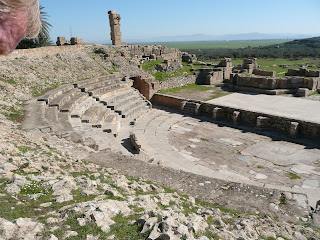
The Roman remains of Bulla Regia pale to insignificance compared with the splendour of those at Dougga but they have the unique feature of underground living amongst the apparent former glory of the aboveground public edifices, the jewel of which is the theatre complete with its bear mosaic. As far as we are aware, strangely, in this town alone, the Romans learnt from the Berber troglodytes that it is cool to live underground and built their homes with rooms below ground arranged around colonnaded atria open to the air. Their palaces and villas are adorned with fine mosaic floors, some of which remain in situ; the most intact and best preserved having been transported to the Bardo Museum in Tunis. Perhaps the finest example on site is in the ‘Maison d’Amphitrite’ where the mosaic of the Triumph of Venus depicts Venus borne by Tritons and attended by Amor, astride a dolphin, carrying her crown, mirror and jewel box.
Had we been a Romans we would have had our names down to live in Dougga as soon as the waiting list was published. Its setting is outstanding nestled into the slopes of the Monts de Tebersouk overlooking a fertile valley and the distant velvet green hills to the south.
Neal reckons it would have been a pleasure to have acted on the colonnaded stage of the second century Theatre to an audience of 3,500 seated in the tiered auditorium seemingly rising to the gods. All he could muster, however, was one!
The Capitoline Temple faced by four monumental Corinthian pillars still bears in its pediment an understandably worn carving of the Emperor Antonius Pius entwined with an eagle. Three internal niches once housed the statues of the Gods, Juno, Jupiter and Minerva now displayed in the Bardo Museum.
The Plaza of the Winds is of particular interest to us sailors as it contains carved in its paviours a compass recording the twelve Roman winds in the quadrants from which they blew. Although we are not yet fluent in the Roman language we recognised one or two of them!
Of the other numerous sites of interest are the Baths of Licinius, a vast complex of hot and cold rooms and gymnasia.Also the House of the Trefoil, the brothel, complete with cubicles for the various goings on but minus its stone phallus advertisement directly next door the Baths of Cyclops with its twelve seater lavatory in a room off the entrance hall. The four S’s were thus well catered for!
The roads in this part of the world are truly Roman and straight as a dye between one town and another except of course for the mountain passes. It was driving along one of these remarkable thoroughfares that we spied overhead the incredible sight of a sizeable flock of storks gently circling on a thermal. Their nests adorn pylons and buildings along the roadside but this appears to be about the southern limit for this fine bird.
And then back to reality where, as soon as entering the Sousse region, the roads got worse and litter abounded. At least our floating home, albeit in a touristy town, is parked in a relatively clean and tranquil Marina somewhat apart from it all.
For those of you in the BBC Radio Solent area who are up and about at the unearthly hour of around 0630 GMT, Miggy is on air again on Thursday the 28th of February on 96.1FM.