Tuesday, August 22, 2006

The Algarve

And so back to Spain after just over a month in Portugal. We are at Ayamonte on the Rio Guardiana, the River that forms the border between Spain and Portugal. Coming into the river we didn’t know which courtesy flag to fly as we crisscrossed the border!
On the whole we have enjoyed Portugal and the friendliness of its people. The Atlantic coast was less fierce than we had imagined due to settled trade winds albeit that we had strong sea breezes in the late afternoon and at times a significant swell.

It sounds strange but we felt Porto and Lisbon to be high on our list of highlights of the Country but they are both intimate and friendly ‘cities’ unlike the vast cities back in the UK.

The western Algarve has a beautiful coastline of craggy multi coloured layered sandstone cliffs with isolated sandy coves and deep caves. It is a desperate shame that these coves and beaches are filled to the brim with British tourists and the cliffs are topped with gross over development of high-rise hotels and apartment blocks. Place names Vilamoura, Praia de Rocha and Almancil may strike the fear of God into you.

We found Lagos pleasant enough as a town, although the language spoken was English. It was here that we first saw Storks who build their nests the size of a mini on top of chimneys, spires, turrets and domes. Apparently the birds migrate to North Africa during the winter here and come back to the same nest in the spring year after year.
It was in Lagos that we said a fond and sad farewell to our very good German friends Michael and Jutta from ‘Allegro ma non Troppo’ who are heading east at a faster rate than us from now on. We hope to meet up with them in the Mediterranean in years to come.

Just east of Lagos is the lagoon at Alvor which is peaceful after the hustle and bustle of the resort towns. Miggy swam here and at the same time cleaned Bella’s waterline.
In the marina at the next stop, Portimao, we first noticed that the boat next to us had a delightful black Labrador on board. A little later we saw that the Dutch boat the other side of us, which was a static ‘live aboard’ catamaran, had a Rotweiler, a Heinz 57 dog, and African Grey Parrot, three Budgies, a Siamese cat and a black Moggie. The Guinea Pigs and Rabbit had died!! All pretty bizarre!!
We quickly transited the resorts of the Algarve to the Rio Formosa, a lagoon on which stands Faro. We anchored for a couple of days just a dinghy ride away from this serene regional capital with its historic old walled town. We were fascinated by the Storks once again and, talking of things that fly, have learnt the livery of every charter airline and budget carrier as the anchorage was directly under the flight path and only a matter of a few hundred meters from the end of the runway at Faro airport. Funnily enough one soon became accustomed to the noise which stopped before bedtime and started at a reasonable hour in the morning.

Further east in the lagoon we anchored off the Isla Culatra, a sand spit that separates the lagoon from the open sea. The tiny ramshackled fishing village, whilst overrun with local tourists at this time of year, maintains its individuality and charm and its incredibly low prices. We had lunch in a no nonsense café of fine crusty bread with locally popular sardine paste, a beautiful selection of fish grilled over wood, a salad to die for, as they say, and a litre of local Vinho Tinto all for 20 euros (£14) for the two of us. Our sole concern at this windy anchorage was other yachts dragging their anchors with the risk of hitting us. Anchoring techniques amongst the French, Spanish and Portuguese leave a lot to be desired with them putting out much less chain than is necessary and choosing positions at which to drop the anchor that belie all accepted practice and common sense. We survived without a scratch however!

A few days ago, luckily whilst on a Marina berth at Isla Canela, we had torrential rain and 50 Knot winds for a few hours. Locals here say that the weather patterns in the Algarve have been unusual to say the least this year. We have had our fair share of strong winds and rough seas while sailing along this coast. Still we are safely tucked up in a quiet Marina on this beautiful River for a few days ‘holiday’.
We have found Internet less accessible along this coast, particularly when we are at anchor. We therefore apologise to anyone who has emailed us within the last two weeks for our lack of reply. Normal service should be resumed from now.

Some of you may have heard Miggy broadcasting on BBC Solent Radio on the 11th of August. Her next ‘appearance’ on the Julian Clegg show is at around 0630 on the 8th of September.

We were so devastated to hear of Jim's (Neal's cousin Lorri's husband) stroke. Our thoughts are with you all and we pray for a quick and successfull recovery. Chhwe nid Jhim to chhelp ush shpik thish chhlankwich.

Our Spanish telephone number is +34 636 587 556.

Monday, August 07, 2006

South West Portugal

We have had a week’s ‘holiday’ in Sines, the birthplace of Vasco de Gama, on Portugal’s Alentejo coast and then sailed around the Cabo Sao Vincente to Lagos on the Algarve. We dipped our ensign and downed a drink a glass of Port as we rounded the Cape, the most southwesterly point of continental Europe and a place off which Lord Nelson fought many sea battles. During our transit of the Portuguese coast we have encountered yachts from twenty different nations – French, Belgian, Spanish, Portuguese, Swiss, Danish, German, Swedish, Finnish, Norwegian, Polish, Latvian, American, Dutch, Irish, Russian, Bermudan, Australian, South African and from St Maarten in the Caribbean. In addition the good old Brits are still here although their numbers dwindle as we head south.

Tall Ships of all nationalities and sizes have crossed our path on their way north from Cadiz to La Coruna from where they set off on their final race to Antwerp. We were particularly pleased to see an old favourite at anchor in the bay here, the ‘Jolie Brise’.
Having written extensively about the places we’ve visited perhaps you would like to hear a little about us and our life aboard. In the four months and 1500 miles that we have been away from the UK we have actually sailed for 39 days. We generally start a passage day, particularly on this Atlantic coast, at about 0600 so as to arrive at our destination before the ‘berthing’ breeze sets in at around Force 6. Being safely on the berth watching others struggle to berth in the wind is better than TV – yachts all over the place fending off everything in sight and loads of shouting! We are not exempt from this I should add but we’re getting better!

On our non-sailing days we simply laze around in the sun! Those of you who know Miggy will know that is not true nor would we want it to be so. If we’re not doing something special like sightseeing, we get up at a sociable hour and have a light breakfast. We used to have toast but the grill warms the cabin too much down here in the heat. Then most days we will go up into town explore and to buy fresh provisions even if bread is our only need. It is invariably ‘up’ the hill into town so it is good exercise for us. After lunch of bread, cold meats, salad, fruit and cheese and perhaps a siesta thereafter, particularly for the ‘old man’, we will tackle household items such as laundry, book keeping, writing the journal and these ‘blogs’ and putting photos and all sorts onto the computer. There is also the mountain of work that goes into keeping a yacht like this in good and clean condition. We are rarely short of something to do but do make time for relaxation as well! A particular mention of Supper and the magnificent job Miggy does in the galley with just two gas rings, an inadequate oven that actually negates roasting, braising and baking, and sometimes a limited choice of ingredients. She concocts varied and delicious dishes that would do great justice to any respectable supper table all in quick time, generally while Neal is drinking a ‘livener’. It is the sauces that make the difference she tells me and I agree. The food on board is so fresh and tasty that we rarely step ashore for supper, perhaps only twice a month to taste national or local dishes. Having said that we appear to be out tonight for an Indian! It’s good to out once in a while as it gives Miggy a rest from the heat of the Galley.

Talking of heat Miggy swam for the first time in Sines in a sea temperature of 18ºC. She thought it was ******* cold. Of course our bit of the Atlantic down here does not have the benefit of the Gulf Stream as your bit does in the UK. Still the sea temperature should rise from now on in the Algarve and then the Med and we have 19.5ºC already. Weather wise in general we have hardly seen a cloud for weeks let alone rain. It can be breezy in these NE trades but daytime temperatures are around 30ºC in the shade and at night we have around 20ºC. Neal is now wandering around in SHORTS and SANDALS and NO socks - whatever next!!

We endeavour to keep the yacht cool in the heat of the day. In the cockpit we have a ‘bimini’ (basically a big sunshade that covers the entire cockpit) and loads of bits of cloth we can zip to it in a variety of places to stop the sun’s rays. Down below Miggy has devised a system based on that she learned from her Dad in India. Curtains at all of the windows, her homemade canvass covers fixed to the outside of the hatches and fans. The sun doesn’t have a chance down here and it is very comfortable.

Miggy’s art is progressing extraordinarily well with her painting local landscapes, buildings and things of interest to remind us of where we’ve been. She is developing her individual style and her technique and style are improving day by day. People, to whom she shows her work, including an art teacher from Lisbon, praise it for its professionalism and quality. Someone has to keep us in the way to which we have been accustomed in later life!

Which brings me to the subject cost of living out here. We reckon that in Spain and Portugal the cost of food, drink and general purchases is about two thirds of the cost in the UK. France was a little more expensive. Marina costs in the north of Europe were again about two-thirds the cost of those in the south of the UK and sometimes very much less. As we are getting further south and here in the Algarve we are paying Solent Marina prices.

We do appear to be under budget overall which is satisfying and, of course, necessary. Yes we actually prepared a budget before we came away based on what we thought would be reality not on what we could afford! Finally we have been delighted to receive emails, texts and phone calls from some of you. As we travel further from you all, although it only takes a day to get back to see you, we do miss you increasingly. Your contact with us helps allay our homesickness, which, although not overwhelming, is present.

Friday, July 28, 2006

Extreme West of Europe

Figueira da Foz is two towns, a lively somewhat tacky beach resort and a charming old town with leafy, shady, cool squares. Wellington briefly made the fort here his base when he landed to retake Portugal in 1808.
We then sailed south into the Estremadura and Ribatejo region and the fishing town of Peniche. During the sail we experienced winds from all points of the compass at strengths between zero and 20knots. Never have we seen so many fishing vessels gathered together in one place. They come and go at all hours of the clock and, together with the tripper boats out to the nearby Berlenga Islands, create and uncomfortable swell for yachts on the visitors pontoon. As well as fishing Peniche is renowned for its lace making. We watched this bobbin lace making at the school of lace making in the town. The products were absolutely magnificent but we were unwilling to pay 250 euros for a 1000mm x 250mm table runner even though it apparently took months to make.

Our sail into the Lisbon Coastal region took us past Cabo da Roca, the most westerly point of the European mainland. Our destination port Cascais is a safe and modern marina with facilities that are reasonable but do not live up to the exorbitant berthing fees! This is the place, however, from which to visit Lisbon and the Sierra de Sintra rather than sail into a dirty, noisy and crowded marina closer to the city centre.

Cascais itself was the summer residence of Kings and adjoining Estoril the haunt of exiled royalty and nobility fleeing European republicanism. Both towns are now beach resorts and business convention locations. Estoril has the largest Casino in Europe.

We have befriended world-renowned classical guiarist Michael Dossow and his wife Jutta; charming Germans travelling to the Mediterranean on their custom built Faurby 42. We have spent happy hours on each other’s yachts drinking tea or supping port. They were kind enough to take us in their hire car to explore the Serra de Sintra, a rugged granite wooded range of hills of up to 500m height, The principle interests in the Serra, apart from the countryside itself, is the Vila Sintra, two Palaces of Kings and a small chapel built high on top of the hills.

Vila Sintra, the old town and a UNESCO world heritage site, with its stunning setting on the north slopes of the Serra has at its heart the huge Palacio de Nacional de Sintra, a royal palace built in the 14th century on a site once occupied by Moorish leaders. The Palacio became the favourite retreat of Portuguese court and was occupied by royalty until the 1880’s. Gradual rebuilding over the years has resulted in a fascinating amalgamation of various styles of architecture and the towering conical chimneys serving the kitchens stand high above the town.

The fairy tale Palacio de Pena, the interior of which was closed, was built by Dom Ferdinand 11 cousin to Queen Victoria’s Albert in an incredible array of architectural styles in the 19th century. The exterior is fascinating with domes, castellated turrets, arches encrusted with neo Manueline carvings and daffodil yellow and strawberry pink external wall decoration. The Palacio, occupied by royalty until the declaration of the republic in 1910, stands in the wooded hillside of the Parque de Pena planted with exotic trees and shrubs.

We took lunch at a tiny village café and ordered the most expensive item on the menu at 6 euros not knowing what we were going to eat. The dish, named Bitoque, turned out to be delicious consisting of a beautifully prepared lean and tender beef escalope topped with a fried egg and surrounded with chips!

We visited the Cabo de Roca, mentioned previously and finished by going to the 17th century Chapel de Peninha perched 490m up on a grey rocks. This tiny chapel has the most beautiful azulejo tile decoration inside and affords stunning views over the coast, Lisbon and the river Tejo.

Lisbon is an intimate city of three parts, the Alfama, the Biaxa and Avenida and the Bairro Alta and Chiado.

The Alfama was the original Moorish settlement, although no buildings of that period exist now. The Alfama now comprises compact houses with facades strung with washing which survived the 1755 earthquake lining narrow, steep streets and steps. This now humble quarter of the city was once occupied by the wealthy who moved west for fear of earthquakes leaving the area to the fishermen and paupers.

A steep and exhausting climb through the Alfama leads to the Castelo Sao Jorge crowning Lisbon’s eastern hill. From here there are spectacular views over the city, the river Tejo and the surrounding countryside.

West of Alfama stands the magnificent Cathedral of Se created in 1150 but rebuilt often over the centuries due to earthquake damage. The internal furnishings and decorations in Portuguese Cathedrals and Churches are austere compared with the overbearing richness of the decoration and the clothed statues of saints found in the Spanish and in particular the French places of worship.

A short walk down the step hill or a tram ride for the less energetic leads to the relatively modern quarter of the Biaxa and Avenida rebuilt after the 1755 earthquake with neo classical buildings and grand squares all integrated into a grid layout. This appears to be the restaurant quarter of the city and we had a great lunch here in one of the thousands of street side restaurants.

Uphill again to the Bairro quarter on Lisbon’s western hill by foot because the funicular was being repaired! This area, first settled by the wealthy from the Alfama quarter and later by prostitutes, now houses small family workshops and cheap restaurants and nightclubs. Finally the elegant commercial district of the Chiado where the affluent Lisboetas do their shopping. We bought nothing but had coffee in the Café Brasileira, once popular with writers and intellectuals. A must for those visiting Lisbon!

Lisbon is a lovely city of great character but the graffiti capital of the world.

We are sitting here on our berth in Cascais marina now on the 27th of July under a cloudless sky and 26º C in the shade (lower than the recent spell in UK we are told) waiting for a replacement battery charger to be fitted and for the wind and waves to calm down.

Friday, July 14, 2006

Arrival in Portugal

The sail down the Minho region coast of Portugal to Viana da Castelo was very enjoyable with a poled out genoa and full main in anything between 10 and 20 knots of wind. Miggy had her second catch of the trip with three mackerel on the line which she gutted and filleted there and then ready for supper that same evening. They taste so good and so different when very fresh.
There are three elements of the weather that one must take into account when sailing down the west coast of Portugal. Firstly and perhaps most importantly the Atlantic swell. It emanates from storms well offshore and is present to some degree most of the time. It becomes critical at about 2.0m to 3.0 metres when some ports may close because it is so dangerous to get in over the sand bar at the entrance. Secondly the wind. The north-easterly Portuguese trade winds are reinforced by local sea breezes to reach Force 6 or 7 by evening time. Most people therefore set sail in the early morning so as to arrive at their destination before the onset of the worst of the wind but having to cope with the third element, the fog. This can take the form of sea fog 4% to 10% of days which lingers throughout the day or coastal mist which burns off around midday.
Viana da Castelo where we stayed for two days is a 13th century town that prospered from fishing. Wealth derived from trade with Europe and Brazil funded the many opulent mansions built in the Renaissance and Baroque styles. The town’s interest today lies in its winding streets and intimate squares.

From Viana we sailed down the coast of the Douro and Tras-os-Montes region to Leixoes, pronounced Layshoesh, the port serving Porto. The Portuguese language is so difficult particularly in its pronunciation. Every Portuguese that we have met to date speaks some, if not near perfect, English. When we asked the boatman in the marina at Viana why he spoke such good English he said that he had been all over the world with the Portuguese Navy and that, if he had not spoken English, he would never have made contact or spoken with another soul.

We caught the metro, built for the European Championships in 2004, into Porto. What an amazing city with its fabulous Cathedral Se at the top of the hill and the riverside district of Ribeira at the bottom full of narrow cobbled streets and tile clad or pastel colour painted balconied buildings. Ever since the Romans built a fort here the city has prospered from commerce. Its wealth was generated from Portugal’s maritime discoveries in the 15th and 16th centuries. Later the loss of the lucrative spice trade was compensated for by the wine trade with Britain.
In the 17th century British traders, cut off from their supplies of Bordeaux by frequent wars with France, took a liking to the full flavoured robust wines of Portugal. But these wines did not travel well so the Traders added Brandy to ‘fortify’ them against the rigours of the Atlantic sea voyage. Before long pure grape spirit was added during fermentation and Port, as we drink it today, was created.
We had a guided tour around the Taylor’s Lodge, one of the oldest having been established in 1692. It is still owned and managed by the founding family descendants. We learned about the vineyards, which are situated about a 150 miles from Porto up the Douro River, the fermenting, blending and ageing and about the styles and vintage. All so very interesting but too long a story to tell here. Taste it as we did at the Lodge and all will be revealed!
Having caught up with the mundane chores of yacht maintenance, cleaning, and the like, including Miggy successfully cutting her own hair!! tomorrow, the 15th of July, we leave Leixoes for the 70 mile sail to Fiqueira de Foz, a lively resort in the Bieras region. We will be glad to be at sea again because it has become so hot – 30 deg in the shade.
Those of you in the BBC Radio Solent region who rise early may have heard Miggy’s regular broadcast on the morning show with Julian Clegg at 0630 on the 3rd of July. Her next scheduled broadcast is on the 26th of July at 0630 or thereabouts.

Our Portuguese telephone number is +351 936 338 049.

Saturday, July 08, 2006

Goodbye to Spain

And so we leave Spain bound for Portugal. This country has a refined culture based upon its rich history and people who are friendly and relaxed, yet efficient.

The north coast of Galicia is beautiful with the Rias Altas surrounded by high hills with their slopes covered with pine and eucalyptus reaching down to the water’s edge. The west coast is more populated with great cities such as A Coruna, Villagarcia and Vigo. Consequently the Rias Bajas on which these cities lie, south of the Ria Muros, have significant development along their shores and are thus less interesting.

We have passed two significant landmarks in our journey or, should I say one seamark, the Bay of Biscay, and one landmark, the Cape of Finisterre. The legend that the weather patterns change for the better south of Finisterre appear to be founded in fact.

A word or two about Baiona where we have spent our last few days in Spain. It is a delightful town with a wealth of history. Perhaps most notable is the fact that it was the port of arrival for the Caravel ‘Pinta’ in 1493 after accompanying Columbus in the ‘Santa Maria’ in the discovery of the Americas. The Spanish have it that Pinzon, the Master of the Pinta, discovered America rather than Columbus who was Italian!

During our stay in Baiona we have visited the ‘Virgin of the Roca’, walked the castle ramparts and the narrow streets of the old town and have taken lunch at the Monterreal Yacht Club of Baiona, an institution known by all sailors who pass this way.

Those of you who listen to BBC Radio Solent early in the morning will have heard Miggy on the Julian Clegg show on the 3rd July. Her next scheduled broadcast is at 0630 or so on 26th July.

Tuesday, July 04, 2006

Costa de Morte and Finisterre

Captain Richard Wilson, Miggy’s great great great Grandfather was stationed with General Sir John Moore at Castle San Anton in A Coruna in the early 1800’s. We viewed memorabilia of that period in the castle and may even have seen a the likeness of Captain Wilson in a painting that depicted General Moore’s death at the battle of Elvina in 1809. The British forces were helping the Spanish defend A Coruna from the invading French army.

Roger and Sue Breese joined us in A Coruna for a week and helped us sail along the Costa del Morte (the coast of death), named such because of the great loss of life in numerous shipwrecks along the rugged, rocky coastline open to the wild Atlantic storms. We had a good fresh sailing wind with a moderate Atlantic swell for our trip to the small town of Camarinas.
It was Midsummer Day and, as is the tradition in this part of Spain, the local population celebrated in the evening with a Sardine supper and fireworks lasting well into the night.

Talking of fish it is interesting to know that, second to the Portuguese, the Spanish eat more seafood per head than any other European nation. Half of this is caught by the Galicians who have 20,000 boats, 90,000 fishermen and a catch of over a million tons. Much of this is Tuna, Sardine, Lobster and Clam caught offshore. In recent years the stocks around the Spanish shores have become depleted due to overfishing forcing deep sea trawlers to travel as far as Iceland and Canada.

Shops here have a wide variety of excellent fresh fish and also of vegetables and fruit. We are at last unable to buy fresh milk however and fresh meat is somewhat limited. We believe that the further south we go and the hotter it becomes the storage of fresh meat becomes more difficult. Hence the preponderance of cured and processed meats. Whatever food we buy is about 40% cheaper than in the UK.

Our next sail south involved the rounding of the infamous Cape Finisterre, the finish of the earth. The sea area Finisterre is, of course, familiar to all of us who listened to the BBC Radio 4 Shipping Forecast. Sadly they have now dropped Finisterre for a curious area called Fitzroy.

Finisterre held no horrors for us and was so calm that we hoisted our colourful cruising chute and later enjoyed an anchorage for the night just round the corner at the Ensenada de Sardineiro, a wonderful quiet, scenic bay with golden sand and stunning wild flowers in the dunes. On then to the Rias Bajas, a series of five large inlets to explore before reaching the Spanish/Portuguese border. The first of these, the Ria Muros was, like the Rias Altas in the north, surrounded by high hills with their steep sides mainly covered in pine forest.

During the sail to Muros Miggy caught four good sized mackerel on one cast from the stern of the boat – her first catch in three months of trying!! They tasted great as a starter to supper that day along with two more that Roger Breese caught at anchor the previous day.

Muros town, where we anchored for a night, was typical of a 16th century fortified Galician fishing port with colonnaded stone buildings, narrow streets and a massive church on the hill above. We called it ‘windy city’ because of the ferocious local winds coming down off the hills overnight and causing us to go gently and not worryingly aground. Our next stop, Portosin, gave us shelter in a new Marina in a pleasant town.

The next and largest of the Rias Bajas, the Ria Arosa, was, in stark contrast to the beauty of the Ria Muros and the Rias Altas on the north coast, surrounded by low hills whose slopes are lined with buildings rather than trees and the lovely smell of pine and eucalyptus. We dropped the Roger and Sue Breese off at Villagarcia where there are good train connections to A Coruna and their Airport. A two-hour train journey costs 6 euros (about £4.50)!! We could not wait to leave this crowded smelly, industrial place. The town of Caraminal on the north bank of the Ria is very pleasant and much undervalued by the pilot books.

Fish farms comprising floating platforms from which ropes dangle in the water on which mussels grow and mature dominate the Rias Bajas. They limit the free sailing in the waters of the Rias.

The beginning of July, our fourth month at sea, finds us in a modern exclusive holiday resort called San Vincente do Mar. The Marina at Porto Pedras Negras on the southern tip of the entrance to Ria Arose is very small and delightful and the staff are friendly and attentive. The facilities are so well maintained that the pontoons have recently been painted with preservative. The conurbation is totally without interest but a ‘boardwalk’ has been built linking sheltered sandy beaches in coves between rocky promontories. The granite rocks, weathered to odd shapes by the wind and waves and pinkish in colour are reminiscent of those on the ‘Granite Rose’ coast of north Brittany.
We are the only visiting yacht in the Marina. As we go south the incidence of foreign flagged yachts is decreasing although we are meeting long term cruisers including a Norwegian and a Finn.

Our next destination was going to be the Ria Pontevedre but the built up nature of this Ria and that of Ria Vigo and the presence of raw sewage not only in the marinas but offshore put us off and we made the decision to sail to Bayona directly where we are now on the 4th of July. It is lovely here and we have finally met up with our friends from Lymington, Peter and Ruth Austin on their yacht 'Jasmone'

Monday, June 19, 2006

Rias Altas, Galicia

This is Galicia where legend has it that the Rias, or estuaries, are the imprint of the hand of God and were created when he put his hand down between the Atlantic Ocean and Galicia.

We are sailing in the Rias Altas, deep fiord like inlets into the foothills of the high Altas hills. The coastline is rugged but the towns and anchorages of the Rias afford great protection from the ravages of the Bay of Biscay.

We have visited the town of Viveiro at the head of the Ria of similar name. The town is of little interest except for the medieval gates and the pedestrian streets but we enjoyed our stay in their Marina. We sailed along the coast with a following wind to Ria Cedeira. Here we anchored in a cove that could be mistaken for a Scandinavian inlet - high wooded slopes right down to the water’s edge and the smell of pine and eucalyptus.

There was great discussion amongst the skippers of the yachts in Ria Cedeira the following morning as to the meaning of the Spanish word ‘Boa’. None of us could find it in our dictionaries, even our yachting terms translations. Some offered the idea that it may be ‘fog’ and they appeared to be right. The visibility soon closed down to a quarter of a mile or less during our passage from Ria Cedeira to Ria Betanzos and our destination of Sada. Thank goodness for the radar to guide us across the entrance to the busy commercial and naval port of Ferrol.

Sada is not the prettiest or most interesting of places but the Marina is sheltered and well appointed. We have cleaned Bella inside and out and caught up with outstanding maintenance. We have also met a number of Brits who are travelling in our direction. A few glasses of wine have been drunk together on various boats as we chat about our exploits to date and our hopes for the future. We think we have made some good friends, John and Mo aboard ‘Blue Eyes’, Paul and Pauline on ‘Shellseeker’ and Stefan sailing single handed on ‘Artemis’ to name but a few.

We took a bus ride to the town of Betanzos, a medieval hill town bounded by two rivers. It is an interesting place with three rich 13th/14th century churches and typical narrow streets with glazed balconied ( Galeria) houses. The pity is that many of the buildings away from the tourist trail are collapsed, at risk of collapse or in a very poor state of repair. How can it be that a place so rich in tourism can be so neglected? The authorities will have to make an enormous effort soon or part of Spain’s heritage will be lost forever.

We had a lovely sail in sunshine, flat sea and 5 – 10 knots of breeze to anchor off Ares in the Ria of the same name. There were thunderstorms overnight. The weather in this corner of the world seems not to be able to make up its mind what to do. One moment the sun shines, then it pours with rain, then thunderstorms and if none of these it’s foggy!

The origins of Ares are Roman and the town has narrow streets with Galerias and red pantile roofs. The cove in which we anchored was quiet and sheltered except, of course, for the thunder and lightning.

Our trip to La Coruna on the 17th June was uneventful. In fact there was no wind and little visibility so we motored the 10 mile passage. The marina is right in the heart of the city next to the old town and fronting the much photographed Galerias on the promenade. The town, which dates back to the Celts, is famous for its Galerias and, of course, as the place from which the fated Armada sailed. It is strange to be in such a place with a quarter of a million population having been used to the relative peace of smaller urbanisation or none at all.

We missed the hourly tourist tram so we had to walk a fair distance to the ‘Torre de Hercules’ which is reputed to be the oldest working lighthouse in the world. As we climbed the first few steps of the internal staircase Neal assured Miggy that the lift was just a few steps more away. The lift never materialised and we climbed the remaining 87 metres to the very top of the tower for great views all round and aching calf muscles the next day. It was fortunate that we visited this monument at this time as only an hour later it was enveloped in fog. We couldn’t even see the base of the tower let alone the top!

Whilst in La Coruna we decided to take a bus trip to Santiago de Compostela some 60 kilometres away. The scheduled bus services in Spain are excellent with comfortable modern coaches running to timetable and clean Stations that look like small versions of airport terminal.

Santiago de Compostela is a 9th Century religious town. It was in medieval times and thereafter the third most popular place of pilgrimage after Jerusalem and Rome. The town is beautiful and the Cathedral magnificent. We viewed Sunday mass during which 8 priests swung a large silver incense burner on a rope suspended from a pulley from the roof so that, lit and belching its smoke, it arced like a pendulum nearly beheading the congregation and at the top of its arc almost touching the vaulted roof of the nave either side. A great show for the visitors! A number of priests of different nationalities were gathered behind the altar one of whom was photographing the ritual of the incense burner. Again we perceive lavish church decoration although this time the town appears as rich as the church. The beautiful buildings and stone paved squares were full of flowers and local entertainers and musicians. We had a lovely ‘Tapas’ lunch in a Cervezeria in one of these squares and all seemed right with the world!

Miggy broadcast her latest spot on Radio Solent on Friday unexpectedly. They inserted another spot due to high demand! Her next broadcast is on the 3rd July at 0645 BST.

We expect and are looking forward to seeing Roger and Sue Breese on Thursday the 22nd of June. They are staying with us for a week and will help us take ‘Bella’ round Cape Finisterre (the end of the earth) to the Rias Bajas.

Friday, June 09, 2006

Bay of Biscay conquered

Whilst Neal was posting the last blog in Piriac Miggy was having her hair cut. She was extremely nervous at the thought of a foreign cut and at the thought of the grey growing through some more but it looked great.
Piriac marina has a sill at a certain level to retain the depth of water in the Marina to an acceptable level. We had great amusement at the French endeavouring to pass over the sill when there was insufficient depth and thus stopping abruptly with a resonant bang and startled faces – when will they learn?


We sailed to Pornic some thirty miles away across the River Loire estuary on the 27th of May. It should have been an interesting trip but we saw very little in the mist that prevailed. We had a fair breeze however and good sailing. Pornic is a fairly large holiday town with bustling streets made more boisterous with fairgrounds, clowns and other street performers as it is Ascension Day holiday. So another four days off work for the native population. How does anything ever get done in this Country?
Miggy has friends from UK, Ron and Fran, who have settled in Pornic and we got together with them on board for a drink and next day they kindly invited us to their house for the day. We had a superb day with them walking the countryside and smelling the agricultural smells that go with it, chatting about our respective changes in lifestyle and eating and drinking heartily. Thanks both for your company and hospitality and to Manny and Charlie for the fun you gave us with the water bombs.
L’Herbaudiere on the Ile Noirmutier was our next stop but we were not enamoured with the place so we had a wonderful sail for five hours next day to Port Joinville on the Ile d’Yeu. This is a delightful place and we would have liked to stay longer but the forecast for a crossing of the bay of Biscay seemed settled for a few days so we left after just a day’s stay on the 2nd of June. Our passage plan had changed to end up further west on the north coast of Spain than originally intended and thus in a better position to explore the Rias, which are reputed to be spectacular.
The distance from Ile d’Yeu to our new destination, Viveiro, is 287 miles or about 50 hours sailing. We left in virtually zero wind and had to motor for the first 10 hours. After that we sailed until nightfall on the first night out when the wind died.
Around lunchtime second day out the wind started to pick up and gradually rose to average force 6 with gusts to Force 7/8 overnight with steep and confused seas. It was most uncomfortable but fast – we were making 7.5 knots average with surfs of 9 knots+. The seas were particularly steep where we crossed the continental shelf where the seabed rises from 4000 meters+ to 100 meters in less than a mile! We were pleased to arrive in the Ria Viveiro at 0900 on the 4th of June.
We were privileged to be visited by Dolphins virtually continuously during the trip and we felt that they were our friends and we hoped that they felt similarly. We even played them Andreas Bocelli singing tenor and they seemed to stop their furious playing around the boat and calm down and just swim alongside us – perhaps we imagine things but we believe that these beautiful mammals have feelings and emotions that may be in tune with our own.

We are now meeting likeminded people who are cruising south with similar intentions as our own and we are getting to know some lovely folks – Paul and Pauline aboard ‘Shellseeker’ and John and Mo porter aboard ‘ Blue Eyes’. We hope to catch up with them as we all travel south down the Spanish and Portuguese Atlantic coasts.
Our first impression of the Spanish, or Galician, people and their outlook on life is encouraging. All those that we have met in the way of our business around the dock and in town have been so accommodating.
We have a Spanish SIM in our mobile now and the number including the international code for Spain is +34 636 587 556.
We will move on to Ria Cediera and then La Coruna in the next couple of days.

Friday, May 26, 2006

Brittany behind us

We were stormbound in La Roche Bernard for five days, in fact it blew force 11 on the night of the 21st May and Miggy was most concerned that some ducklings she had been nurturing wouldn't survive - but they did. There could have been worse places to ride out a storm than nine miles up a beautiful river in a charming town. A town full of resident Brits most of whom come from Lymington it seems. Martin Nash and Sally Muir, Royal Lym YC members, have a house on the quayand were kind enough to invite us round for drinks where we met Peter and Pam Betteridge, who did a radio course with us, Malcolm and Carole Edge again, Mike and Penny, residents of La Roche Bernard and John and Moira from North Wales.
We nearly killed the aged computer in the internet cafe trying to post our blog! Sally Muir let us do the last one on her laptop. Internet access points in France are few and far between and those that exist possess ancient hardware or out or date software that won't accept memory sticks or CD's, or the machine has been programmed not to accept such things to guard against possible viruses. Hence we have to type the blog at the internet cafe rather than at leisure on or own machine and are generally unable to post photos.

We also got to know some delightful French people. Jean Paul and Annie live in Perros Guirec and come down to La Roche Bernard in their tiny motor boat on the canals from St Malo. We took pity on a young couple, Vincent and Pauline, being bounced about in the waves on our pontoon in their 22 foot Etap sailing boat and had them aboard Bella for lunch. He is a backstage director and she a costume director at the French National Theatre. We hope to see Vincent in Spain as he intends to overwinter in La Coruna.

We had primed you to listen to Miggy on Radio Solent last Tuesday. The interview was postponed a few minutes before the scheduled broadcast time because Julian Clegg had to chat to a guy who had phoned from the top of Everest. The spot is reprogrammed for Monday the 29th May at 0645 BST.

The weather relented somewhat so we left La Roche Bernard, our last stop in Brittany, and sailed for Piriac in Loire-Altantique on the 23rd May. The sail was short and boisterious but enjoyable although motoring down the river to the sea was a bit tedious into the headwind and we were delayed at the lock at the Arzal Barrage for an hour! Piriac is a charming 17th Century hamlet about 10 miles north of the River Loire estuary. It is good to be in salt water again and to see phophorescence at night in the loo! We have eaten well in Brittany with wonderful fresh vegetables and fruits from the markets and shops and a wide range of fish and meat that you do not see in UK. To mention Cassoulet de canard, Coquille St Jacques, St Pierre, Merquez, Beef filet hachè will make your mouth water.

We saw tiny British Storm Petrels on the way to Piriac who skim the waves in search of food, graceful Terns and more funny little guillimots.

We have sailed a total of 545 miles to date around coasts and up and down rivers but still we are only 200 miles south of Lymington! Hopefully our new running log will continue to record our mileage correctly.

We intend to sail to Pornic from here tomorrow and then to Ile Noirmutier and Ile d'Yeu from where we intend to cross the Bay of Biscay to Spain in mid June.

Saturday, May 20, 2006

Force 10 in La Roche Bernard


There was great rejoicing, not only by us but by the Harbour Office crew as well, when our Tridata instrument finally arrived from Paris on the 17th of May a week and a half after being ordered. We stayed in Port awaiting its delivery much longer than intended, of course, although we put this time to good use in catching up with the maintenance (Miggy teak oiling everything that didn’t move and Neal greasing everything that did). The Maintenance Schedule is now almost up to date.

We met a Dutch couple, Peter and Lineke Steerenberg who are on the way to La Coruna to overwinter. We hope to meet up with them again in Spain later this year.

Both the late Eric Tabarly’s yachts, Pen-Duick, a beautiful gaff rigged cutter, and Pen-Duick 11, a ketch, were in Port Haliguen. What a tragedy that Tabarly should have lost his life by being hit by the boom (quite near here). Was it complacency built out of experience or a desire to conclude his adventure filled years in a familiar and much loved place – the sea?

Miggy was overjoyed at the size and diversity of the market at the nearby town of Quiberon. The walking over the past few days has taken its toll on her, however, with blister upon blister on her little toe! It is extremely painful and will need rest for a day or two.

Talking of rest we are both reading avidly, a pastime which is new to us. Neal has finished three books since our departure and is now well into the ‘Da Vinci Code’. Don’t worry Johnny we have both read Richard Bewes’s treatise on the resurrection and we are looking forward to find out from Michael Green whether or not Jesus really did have a baby with Mary Magdelene!

We met our first British yacht since leaving Guernsey on the 14th of May. She is named ‘Frosette’ and is sailed by Sir Malcolm and Carole Edge. They are Royal Lymington members and delightful people. We had drinks on their yacht and they had wine with us on ‘Bella’ at La Roche Bernard where we are now, the 20th of May, berthed.

We sailed to the Vilaine River on the 17th of May, went through the lock at the barrage at Arzal up river to this delightful medieval town which appears to be mainly populated by the British. It is said that the Marina here is 30% occupied by British yachts, one of which is ‘Frosette’.

We are now experiencing gales and last night storm force 10 so we are precisely in the right place – up a river well away from the sea! Having said that its pretty rough here in the Marina! More storm force winds forcast for a couple of days.

It was good to speak with some of those at home who we miss so much - Betsy on her birthday along with David and Danny and Marion who were also celebrating birthdaays. We are glad that you are all in fine fettle. We have also soken to Ian and Sue. Thanks, all you are doing is of so much comfort to us – we look forward so much to seeing you in July. And Roger and Sue we look forward to your stay with us in June.

A reminder that Miggy is due to speak on Radio Solent 96.1 FM at 0645 on Tuesday the 23rd of May. This is also Betsy and David’s Diamond Wedding Anniversary. We shall be thinking of you on this momentous achievement.

Thursday, May 11, 2006

Winding down - Southern Brittany

Why Port La Foret should have a 1000 boat Marina when it has a natural sill of 0.6m I will never know. The Marina is a stagnant backwater and not worth visiting although we had to to meet the electronics guy to fix our instruments. He spoke good english and was helpful although you have already read the saga of delivery! The town at Port La Foret even conjured up a real transvestite who was doing his/her shopping. Miggy reckoned it was on the pickup trail.

We next went to the Belon river, the place where the best Oysters come from. Considering that neither of us like Oysters, the fore and aft mooring was peaceful. We did not find the Belon river as beautiful as the River Odet but the Odet is exceptional. We met Phil annd Lisa Bennett who rafted next to us in their Southerly 13.5 "Kind of Blue". We had to lend them our dinghy when Phil capsized his delivering the first of his crew to the shore for supper.

The following day saw us in Port Tudy on the Ile de Groix. It was bank holiday sunday so it became crowded with weekend yachties; It is a very small, pretty, harbour and we wondered at the number of yachts that could be crammed in still allowing room for the ferry to turn and dock!
We were entertained by a large resident Dolphin that plays with jet skiers and everything that moves. Miggy had the fortune of a visit from the Dolphin which came right up to the quarter of the boat and had a chat with her. Monday dawned more peaceful, the weekend guys having gone back to work ha! ha!

We hired cycles to tour the island and had a picnic by a small reservoir on the coast. It was idylic with only the sounds of pheasants and a cuckoo. We cycled about 10 miles and felt good and we considered we had earned a meal ashore!

We had a good sail to Port Haliguen where we shall await the package from Paris. Time for rest, scrubbing, cleaning, washing clothes and maintenance as well as reprovisioning the yacht at the local supermarket. Warm weather brought out the bimini ( permanent sun shade fixed over the cockpit of the boat); To our surprise it was holed where the cloth had chafed against the wire backstay on which it is stowed. Miggy spent an afternoon sewing on reinforcement by hand.

Friday, May 05, 2006

24 degrees C

Our passage to the River Aulne was started in virtually zero visibility but we programmed in a load of waypoints (positions to which our electronics will guide the boat) around the Crozon peninsular and into the Rade de Brest. Once in the Aulne the fog lifted and the beauty of the scene emerged. How odd to be sailing up a River with trees and fields in a seagoing yacht.

Having negotiated a lock where the keeper looked so nonchalent that he might have seen British yachts pass through every hour we spent the night 20 miles inland at Chateaulin where the Mairie granted us a free night. A lovely day on the river said Ratty!!!!

Woke up the next day to cherry blossom in the cockpit and the sounds of the market nearby where there was beautiful fresh fruit, veg and fish. There was an English telephone box here painted in proper red.

Next day we motored a mile downstream to Port Launay, a tiny and very pretty village. We had to go to the Mairie to pay our dues and electricity charges of 4.50€ total where we were greeted by the Mayor. Some time later the electricity broke down, as it tends to do in this part of the world, despite all their nuclear power and wind farms, and Miggy trundled off to see the Mayor to get it fixed which he duly did! We were moored on a grassy bank opposite an English B&B just renovated and set up by Susan (Hyacynth) and Ivan.

On the way back down the river early the next morning we spotted an Otter which was as surprised as we were. We had planned to go to Brest this day but changed our minds for a fantastic sail and a prettier destination further south, Morgat. It is actually a posh holiday resort
which is not yet open for the season. After being assured there was Gas a kilometre or two distant up the hill we found none - good excersise though!

An 0700 start next morning we set off south to face the Raz de Sein, a narrow passage between devillish rocks in which the tide runs at up to 7 knots, and where it is said there be dragons! We picked up a bouy at the end of a 55 mile passage at Sainte Marine on the opposite side of the River Odet to Benodet. The following day was May Day and, surprise surprise, France was closed. Miggy negotiated the task of preparing the dinghy and outboard all of which went very smoothly.

We had decided previously that we wanted to sail inland up the River Odet the next day and it was just as well we did because the wind got up from the south which made our mooring untenable. After going aground at our intended anchorage of Anse de Combrit we went further up river and dropped our hook at Porz Meilou. We were the only boat in a beautiful setting with high wooded banks and birdlife - peace!
On our way back to Sainte Marine we saw Miggy's old Sigma 33, now named 'Ysbryd Antur' moored just up river of the bridge at Benodet. We had a visit from Customs in their rib who wanted to see our passports and the ship's papers. They appeared grumpily satisfied and gave us an official bit of paper.
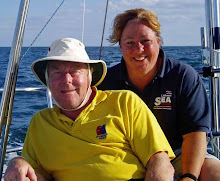
We are now in Port La Foret aftyer a great sail from Benodet. We had not intended to come here but our 'log' (mileometer) is playing up and we need a new unit. The electrician who can supply the new bit has his office here and has undertaken to help us. It will take one week, at least we expect, for the old unit to be sent to Paris and the new unit the to arrive from Paris!! We should be thankful for the efficiency we take for granted in England.