Wednesday, October 24, 2007

Fast Sailing and Stuffed Camels

The last part of the season’s adventure took us across the bay of Tunis to Cap Bon and then south to Kelibia and across the Bay of Hammamet to Monastir where we will winter.
We experienced the best sailing of the season during this time averaging 8 knots for the forty miles from Sidi Bou Said past the Ras el Fartass, no joke, to Cap Bon and the same for the final 15 miles from El Kantaoui to Monastir. All this was done with a fresh breeze, close to beam reaching with full sail, flat seas and sunshine.
Kelibia port is a massive and busy fishing harbour with little room for pleasure yachts, although we were made to feel welcome by both the Police and the Capitainerie. Mooring, water and electricity cost about 10.00TD per night (£4). We are berthed alongside four deep but the harbour is well protected and devoid of swell apart from fishing boat movements evening and morning. The port is dirty and the water putrid but there is interest and spectacle here. Strolling around the immediate environs of the port we were struck by the accumulation of plastic bottles, paper and other rubbish and dirt. The Tunisians don’t seem to have a strategy or public service for collecting rubbish from streets and public places. Home owners and shopkeepers wash the pavements outside their properties and a street cleaner sometimes sweeps the road gutters but nothing else seems to get done.
A taxi ride to the north of Kelibia on Cap Bon lies Kerkouane and the remains of a Punic town unearthed as recently as 1952. The settlement, with a population of 2000, dates from the 4th century BC and has been remarkably well preserved since its demise during the second Punic war in the 2nd century BC. The size of the houses, the wide streets, the town planning, architecture and the construction of the buildings suggests a sophisticated society with a high standard of living.
The remains of the houses show a layout with a central courtyard, not that different from the Arab dwellings of today and a partial upper storey. They are complete with sanitation including hip baths and basins still retaining their original water resistant murex purple dyed rendering. Lead pipes connect sink and bath and drain the bath to external gullies.
Many nearly intact opus signinum (a kind of compacted earth render) floor coverings inlaid with a mosaic of tiny stone fragments exist today some 3000 years since they were laid. The museum houses artefacts of pottery, exquisite jewellery and metal coinage that further emphasise the sophistication of these people. To visit such an ancient relic was a truly remarkable experience enhanced by the fact that we were the only tourists on the site.
We were very happy to have our first phone call on our Tunisian SIM from Miggy’s sister, Jane Gillbe. They are coming to stay with us for a couple of days in November having visited Tunis, Carthage and Sidi Bou Said on the way.
It’s not that the flies or the filth that drove us away from Kelibia and we did enjoy the authenticity of this wholly Tunisian fishing port and the lack of tourists but it was time to visit some of the sanitized ‘Zones Touristique’ of Tunisia. These are areas dedicated to the tourist where you can drink alcohol in a bar or restaurant on the street, at tourist prices mind you, without having to sit inside out of site and where street cleaning and rubbish removal services do exist.
Our course took us past Hammamet town where I spent my first package holiday some forty years ago! Things have changed massively since then with the development of the whole coastal strip with hotel complexes, albeit reasonably low rise.
Marina Jasmine and its surrounding development was completed only five or so years ago and is the largest and most spacious yacht harbour in Tunisia. It is spacious and the services are intact and well maintained. It was the first day of low season and the price per night was only £12. After the multitude of flies in Kelibia it was refreshing to find only the token fly to slaughter. It is clean here if not to say sterile. The Zone Touristique immediately around the Marina has unoccupied shops and restaurants and the main drag outside comprises five storey flats built in a long line and masses of souvenir shops.
We were able to access the internet at the Marina for the first time for ages and we had 25 emails including news from family, Ted and Iris, Ian, Jon and Genevieve and Paul and Pauline. Great to hear from you all.
The next port of call, El Kantaoui, although a recent Zone Touristique development, has been nicely planned along the lines of an Andalucía village. Unlike Mammamet Jasmine it is not soulless and there is much activity in the bars and souvenir shops around the dock sides. The Marina is not as spacious and serviceable but the place has character. Having said that there is little here that is truly Tunisian.
Finally we reached Cap Monastir Marina and, after a good deal of wrangling and a few threats about going to press issued, of course, through smiling lips Captain Jalel Ben Salem came up trumps with a splendid berth for us for the winter. He, his secretary Corin, Berthing Master, Marjoub and assistant and diver, Makhram (the latter two please forgive our spelling if you read this) are really extremely helpful, efficient and friendly. The diver ties two bow anchor lines (if one is stern to the dock) to whatever anchorage points he has on the sea bed as this apparently is the best method they have devised for keeping the boats secure during the northerly storms that we are going to experience during the winter. In fact we had one in the last day or two with 40 knot winds and we are still intact and in place!
Miggy’s birthday and the end of Ramadan coincided. Miggy, amongst most generous gifts from others, received the iconic Tunisian souvenir, a stuffed camel from me; not a real one I might add as that would be smelly. Miggy wishes to thank all who sent birthday greetings by phone, email and card. Our friends, John and Annie Corden, who christened Miggy the ‘small and noisy one’ came up with a great card the inscription on the front of which read ‘Happy Birthday to a girl who brings beauty and joy to the world......with lots of noise’. At the end of Ramadan the area became alive with local Muslims frequenting the cafés, smoking themselves to death and, for all we know, having sex during the day!
Others who may sail in our wake in the future will be well advised to read this next piece as the regulations for Visas are not adequately or fully explained in the Imray Pilot book or, indeed, in the most recent edition of the RYA’s C2/05 publication ‘Foreign Cruising Vol 2’. On entering the Country by yacht one’s passport is date stamped and one is entitled to stay for up to 3 months. To extend ones stay, at the end of 3 months one must either obtain a Visa at a price or leave the Country and return. The price of the Visa is 10TD (£4.00) per week for the remainder of the time one remains in the Country after the initial 3 month period.
Monastir was founded by the Phoenicians in the 10thC as a port. Julius Caesar camped her in 46AD before the battle of Thapsus. The town’s main attractions include the 10thC Ribat, the oldest and most intact of its type, the adjacent Grand Mosque and the walled Medina.
Monastir’s most famous son is former President Habib Bourguiba, founder of Independent Tunisia. Although now entombed in his grand mausoleum, he is omnipresent through his golden statue as a boy, his mausoleum, his controversial and vast modern mosque, the seafront esplanade and, indeed, the Marina in which we lay.
It is interesting to note our cruising statistics for the season if only see the remarkable similarity to those of last season:
2007 2006
Distance logged 1764 NM 1768 NM
Ave speed 5.25 Knots 5.25 Knots
Under canvas 27% 28%
Motoring/motor sailing 73% 72%
Days at sea whilst In commission 34% 33%

The remaining days in commission were spent either at anchor or in dock with raised glass in hand in a toast as always to:
ABSENT FRIENDS.

Wednesday, October 17, 2007

The Bay of Tunis

We paid the Capitainerie at Bizerte a princely 132 Dinars for our six night stay. This equates to about £9 a day for mooring, water and electricity. We also completed formalities with the Garde National. The young chap we dealt with didn’t know what to do and had to be advised by the Douane. What he had to do amounted to writing on a scrap of paper who we were, our official number and where we were going! It’s all good work for the working man to do!
It was a pleasant trip with bacon sarnies for breakfast and a feeling of wellbeing. From Bizerte to the Bay of Tunis the coastal shrub clad hills are progressively scattered with a patchwork of cultivated fields. The fertile Oued Medjerda river delta and valley, once the granary of Phoenicia and Rome and still agriculturally important today, hove into sight to the west as soon as we had rounded Cap Farina into the Bay. The region owes much to the Arab immigrants who arrived from Andalucía in the 17th and 18th centuries. Besides cereals and vegetables they began to grow almonds, figs, citrus fruit and grapes. The coastal belt becomes increasingly developed with fashionable holiday resorts frequented mainly by the well off Tunisians as we sailed south towards Tunis but the development is sympathetic with the surroundings.
We were berthed in the Marina, said to be the most expensive in Tunisia at £16 per night all inclusive, with Sidi Bou Said looking charming up on the hill above us with its whitewashed houses and blue mashrabiya shutters, balconies and doors.
Formalities with the Police involved giving the Officer 100 cigarettes ‘Backshish’. This is perfectly normal in southern Tunisia and, as in our case, may be requested blatantly. It is wise to conform with this tradition as it will save a great deal of aggravation and inconvenience and possibly an inordinate amount of time spent completing paperwork and the like.
The walk some three to four hundred steps up the steep hill to Sid Bou Said was exhausting and sweaty in the mid morning sun. The blue doors in the village are only superficially identical. They differ in the pattern of the studding with popular motifs such as moon crescents, stars and minarets.
Sidi Bou Said is named after a 13th Century ‘Sufi’ holy man who settled here on his return from his pilgrimage to Mecca. It became a centre of ‘Sufism’ and as such a place of pilgrimage. The tomb of Sidi Bou Said is visited by the Muslim faithful to this day.
The village is still bustling with pilgrims who come not only from Tunisia but from all over the world. They crowd the narrow cobbled streets and barter in the souks for precious goods to take back to their own countries. These faithful are called tourists and they come in their bus loads. We are, of course, tourists and so cannot complain but it is better to see the village after the tourists have gone when it is taken over by the locals. An hour spent over a café turc smoking a ‘chichas’ or Hookah at the famous Café Nattes where the likes of Jean Paul Sartre, Andre Gide, Simone de Beauvoir and other artists of the time used to hang is exceptionally relaxing and atmospheric.
We gazed from the terrace of the Café Sidi Chabanne sipping a Thé au Pignons, mint tea with pine nuts, over the beautiful Bay of Tunis and at Bella sitting peacefully on its mooring in the Marina below.
A visit to a traditional Sid Bou mansion still occupied by a lawyer and his family was fascinating. Those of the fifty five rooms that we saw together with the cool courtyards and gardens gave a real insight into the life of the well off middle class of Tunis many of whom have their mansions in this area. The panoramic views from the terraces were stunning stretching from Tunis itself to Carthage and over the Bay to the hills to the south and Cap Bon to the north around which we shall sail when we leave this delightful place.
Sidi Bou Said is famous for its beautiful ornate white painted birdcages. They resemble the curved window grilles found in the wooden shutters of Arab houses but they look like miniature mausoleums.
Just along the bay from the Marina is the Presidential Place compound. It is well protected as you would imagine even from seaward. We must not deviate far from our course when we leave for fear of capture, if not foundering from hostile fire!
The alarm woke us early with the view of travelling to Tunis in the comparative cool of the day before the sun gets too high but, of course, it was cloudy and rain was falling as we alighted from the TGM train at Tunis Marine Station. The TGM sounds awfully grand for the noisy, bone shaking contraption that we were on but it got us there in less than half an hour at the ridiculous fare of about 80p for 1st class return.
Tunis dates back to the early days of nearby Carthage and there is evidence that it existed from the first Punic War. Destroyed in 146BC, it wasn’t until the 7th Century that the Arabs recognised its strategic importance and developed the city, starting with the Great Mosque in AD732, until it became a major centre of science, culture and religion in North Africa. With trade flourishing between Europe and the East, Tunis became an Arab metropolis and capital.
The city centre divides distinctly into two halves, the modern metropolis built mainly by the French and the historic UNESCO World Heritage Site Medina, little changed since medieval times, full of Mosques, souks and ancient palaces.
The 8th century Great Mosque some of the original of which remains to this day stands at the heart of the city amongst the cobbled narrow streets of the bustling souks. The prayer hall and courtyard of this Mosque, indeed any Mosque, are sacred ground and, as such, entry is forbidden to non Muslims. It doesn’t seem right, does it, when a person of any faith can walk into say Canterbury, Salisbury and York Cathedrals.
The medina has over twenty souks forming one vast animated marketplace surrounding the Great Mosque. The principal souks for upmarket goods such as jewellery, religious books, carpets and perfumes were closest to the Mosque and those that were smelly or dirty, such as tanning leather are furthest away.
Talking of carpets, all ruses are used to try to get you to buy one. An invitation to get a panoramic view over the Mosque will inevitably end up in the invitee’s brother in law’s carpet shop. We have successfully resisted such attempts by saying ‘no, bugger off’ in the nicest possible way through gritted teeth but with a smile on our lips.
The Tour bet el Bey is unique. It is a mausoleum for the Beys, 18th century Husaynid Kings, their wives and dignitaries. Their tombs are crammed into exquisitely tiled chambers with beautiful fretwork plaster ceilings and domes. The men’s tombs are topped with marble fezzes or turbans and the ladies with a headstone at each end.
We witnessed the severest thunderstorm either of us has encountered. The fork and sheet lightning was markedly dazzling and too close for comfort coming, as it did, only a second before the ear splitting thunderclaps. The rain fell in torrents sometimes as massive hailstones. It stayed over or around us for at least eight hours and Miggy reckoned it was reminiscent of those she had lived through during the monsoon in India.
People say that the Roman remains at Carthage are an anticlimax in that what there are of them are scattered widely over a large area amongst the mansions of the rich Tunisians. I must admit that I was here over forty years ago and remember little although that is probably nothing to do with the impact the site had on me but more the loss of memory due to age.
We limited our visit to a few ruins in close proximity to one another, the Antonine Baths, the remains of villas and Hadrian’s Palace, Hadrian’s theatre and the museum, and we found them all fascinating.
Carthage was founded in BC814 by the Phoenicians and by the 4th century BC had become a major force in this part of the Mediterranean. The Romans raised it to the ground during the Punic wars and re-established it as a huge city of great influence. It gradually fell into ruins following its occupation by the Vandals, the Byzantines and finally the Arabs in 695AD.
The best preserved of the Roman ruins are the Antonine Baths. These 2nd century AD baths were once the largest in Africa and they are vast and very impressive particularly when filled with water as they were after yesterday’s storm.
Land and sea trade grew under the stable rule of Caesar Augustus in the 2nd and 3rd centuries and that resulted in the growing prosperity of the inhabitants of the city. The ruins of the villas and Hadrian’s Palace clearly show the layout of the accommodation and the street plan. The original intricate mosaic floors are in good condition to this day.
Hadrian’s theatre, although mostly rebuilt, was evidently a feat of construction in its perfect semicircular form. The magnificent thing is that it is still used for performances of theatre and music.
It is extraordinary that we were alone at the last two sites. The helter skelter schedule of the organised tours no doubt allows no time to see these extremely fascinating remains of a great Roman city.
The museum is a little disorganized but displays some ancient and extremely interesting Punic, Roman, Christian and Arab artefacts taken from the site of Carthage. The museum stands on top of Byrsa Hill where the Roman Forum and Capitol used to dominate and overlook the city. Ruins of the buildings still exist as well as the foundation of Punic houses nearby.
We will remember with affection our time in the Bay of Tunis as we will meeting and taking wine with Yannick and Denise, a French couple from Vannes and with Ken and Maureen, an American couple who have been cruising the world for a long time and who, as well as speaking Italian and French, are, astonishingly, fluent in Chinese.
Some of you may have heard Miggy on BBC Radio Solent on Monday the 8th. Her next broadcast is on the 12th of December sometime between 0630 and 0645.
We have now arrived at our winter base, Monastir. We will publish a blog about the east coast of Tunisia from The Bay of Tunis around Cap Bon and south to our present location in the very near future, that is, when we can find internet access. Our address here at Monastir is:
S/V Bella
Marina Cap Monastir
B.P.60, 5000 Monastir,
Tunisie
Tel: +216 214 353 17

Tuesday, October 02, 2007

First Impressions of Tunisia

Having settled the extremely generous fee for our extended stay, averaging only £9 per day inclusive of hauling out and relaunching, the totally unexpected happened as Antonelli, the dour and sometime abrasive Marina owner, came to the boat and gave us an inscribed bottle opener in the shape of a workman with hard hat as a memento of our stay at Marina del Sole, Cagliari. I am sure I detected a tear in his eye. In any case we were absolutely delighted and a little flabbergasted.
An 0830 start found us motoring away from the marina Del Sole, a place along with Cagliari itself, which we had come to like very much. A base here would not be the worst in the world with its easy access to the pleasant cruising grounds of Sardinia, Corsica, mainland Italy the French Riviera and the Islands between.
As soon as we had cleared the confines of the Golfo di Cagliari and were in deep water Miggy cast her new game fishing tackle. She was becoming disillusioned at not having a bite when the strike came and for the next hour and a half Miggy fought with this creature until it gave up. She was black and blue with the scars of the battle with a Tuna of around 12 kilos or 25 lbs. To cap it all we had to take dramatic action during this struggle to avoid a massive tanker that had taken a dislike to us and was determined to send us to the bottom of the ocean.
This wasn’t the only fish we caught as overnight our first flying fish landed on the deck. In total contrast to our previous catch it was about 15 cm long!
We and the locals have been saying that this has been an extraordinarily windy year. Once again despite the forecast for light to moderate conditions, we encountered force 6 winds overnight from around 2000 to 0500 the next morning. Bella romped along at 7 knots plus enjoying every minute but I’m not sure the crew were quite as enamoured. Spectacular stars shone out of a moonless sky and our wake echoed their brilliance with sparkling phosphorescence in islands the size of dinner plates.
An easing of the wind and sea state as we threaded the Galite Islands and a bacon (brought back from the UK) roll soon restored the crew’s zest for life in time for our arrival at the Tunisian port of Tabarka at 0845 on the 13th September where Miggy directly butchered the fish. We had covered the 147 mile passage in just 24 hours. Tabarka is only about fourteen miles from the border with Algeria, which remains an unwelcoming land into whose waters we are glad we did not stray.
Entry formalities into Tunisia involve a lot of walking between the Offices of the Harbour Authority, Customs and a multitudinous number of Police Forces but we gained our ‘Permis de Circulation’ in the end.
We got a ‘Tunisiana’ SIM card after much tooing and frowing including the production of a passport! The number is 00216 214 353 17.
After a delicious supper of fresh caught Tuna steak washed down with Sardinian vino rosso at 1euro per litre we went to bed only to be woken cruelly at midnight by a violent thunderstorm with torrential rain and winds gusting at 40 knots or more.
The harbour of Tabarka has disgustingly filthy water and electricity and water facilities are either broken or have been repaired by Heath Robinson. The town is awash with dirt and discarded litter and rubbish from overflowing bins ground into the pavements. The dockside is awash with feral cats all of whom want to join us as crew! It is not a place in which we would like to spend any length of time. It is however reputed to have excellent diving as there is rare red coral which is savagely harvested.
There are a lot of prayers being sung all day as, not only is it Ramadan, but it is also the Muslim holy day. A maroon was launched at sunset to let the Muslim populous know they could eat, drink and be merry until sunrise. Thank God we don’t take Lent as seriously as this.
The coastline of this northern coast of Tunisia is mountainous interrupted with sand dunes and beautiful white sand beaches. The laurel, mimosa and herbal plants on the hillsides are surprisingly green. The valleys just to the south of the coastline are reportedly fertile with pine, cork oak, eucalyptus and oleander as well as fruit orchards. The region is known as ‘Green Tunisia’
Just five or so miles to the north of Bizerte we passed Cap Blanc which is the reputed to be the most northerly point of Africa although the geographically correct northern tip of the continent is Ras Ben Sekka which we sailed past a few miles to the west.
Our first impression of Bizerte was good. The welcome and assistance of the Port de Plaisance ‘Surveillants’ on our arrival, the ease of formalities and the clear blue water and fresh air all being in total contrast to our experience at Tabarka.
Bizerte has the dubious claim to fame of being the last stronghold of French colonialism. Around 1600 Tunisians died in the battle here in 1961 when Bourghuiba finally ousted the French. The harbour has been of strategic importance since the Phoenicians settled here around 800BC and has been fought over since by everyone including the Romans and Turks and it was settled by the Spanish Andalusian Moors in the 17th century.
The Old Port area is attractive, the small quay being lined with fascinating buildings. The entrance is guarded by the Kasbah on one side which houses the Great Mosque and a huge Medina and a citadel or fort on the other. The produce on sale in the vast fruit and veg and fish and meat market is not as plentiful or diverse as we have experienced in Europe. In fact the fruit was overripe and needs to be bought daily. We withhold judgement on the meat and fish until we have tried it.
The daily rate for berthing in ports along the north coast is around £8 inclusive of water and electricity and it is still considered high season! Let’s hope this keeps up for the Bay of Tunis where next we are headed. Let’s also hope that we can access the internet more often than at present.

Tuesday, September 11, 2007

North for summer, South for winter

Somehow during the flight back to the UK we managed to get involved in an argument with an odious chap sitting next to us. The reason matters not but his final words are worthy of note and they were ‘’...I demand to see the Captain. I want these people (us!) thrown off this aircraft.’’ – and this at 37,000 feet!
We certainly escaped the heat of the Mediterranean summer by going back for the English summer. As we arrived the North had just experienced and the West Midlands and Thames Valley were about to experience their worst flooding in centuries. The temperature seldom rose above 17°C below the thick blanket of cloud that covered the Southern skies. It was only during the last week of our seven week stay that the clouds cleared to expose the sun.
It was good to see family and friends again. Close family met in the beautiful churchyard on Chosen Hill overlooking the Gloucestershire countryside to dedicate the headstone at Miggy’s father, David’s, grave. Johnny led the short, moving service of prayers in his usual committed, caring and relaxed style
We had a great BBQ at my cousin Lorri and Jim’s where we caught up with the news from my family including, Danny, Stan and Pat and Joan. We learned to play the ancient game of horseshoe throwing and a modern electronic one.
An unfortunate event, that of my Uncle John’s funeral brought us together with my father’s side of the family for the first time for ages including Godfrey and Debbie and Dianne and John. We also met with Beryl and Gerry with whom we were to share an enjoyable time at Sunday lunch in the Royal Lymington Yacht Club a little later on.
A pleasant drive through the Garden of England found us in Deal visiting Marion Satterley and meeting Peter and Mary Crowther, Miggy’s brother in law’s folks, at the Royal Oak, Langstone Harbour for lunch was a real pleasure.
Meeting with friends was a pleasure. We were honoured to be included on the exclusive guest list for Sue Burr’s birthday supper at The Mill, Gordleton. To be invited to Adrian and Clare Whinney’s little boys Josh and Hamish’s baptism was a privilege and it was great to catch up with Adrian and Clare at the BBQ afterwards. Fun times with Ted and Iris Watts, John and Annie Corden, Ken and Jackie Hay and Roger and Sue Breese, mostly over the supper table or round a BBQ reminded us, not that we needed to be reminded, what treasured friends we have back in old Blighty.
We arrived back in Cagliari, Sardinia to be met by Gary in the Marina’s limousine. The limo is an aged battered Fiat Panda and the chauffeur, Gary, is an English legend in the Marina del Sole who willingly helps people in all manner of ways and is a fountain of knowledge on local people, places, goods and services. The Marina is run by father and son, Antonelli and Massimilio, who welcome visiting yachts and charge reasonable, if not inexpensive, prices for this part of the world.
Poor Bella, who had been propped up on the hard standing since our departure for the UK, was filthy. Her decks, coachroof and cockpit, having been immaculate on our departure, were covered with dust from the yard and also with half the Sahara Desert that fell with the rain in a recent Sirocco, a warm wind from the south. She was launched the day after we got back and then scrubbed up very well to look like new. We have provisioned Bella for our onward journey with tins and tins of European food just in case we tire of couscous and with wine by the flagon at 1 euro per litre. Actually it’s very quaffable.
The weather courtesy Cagliari Navtex and local forecasts looks set fair for our 24 to 30 hour passage to Tabarka, Tunisia starting on Wednesday the 12th September. Tabarka is the most westerly port in Tunisia just inside the border with Algeria. From there we will cruise the north and east coasts of the Country until we reach our winter berth in Monastir on or about the 15th October. This will encompass the entire length of Ramadan during which, from sunrise to sunset, Muslims must not eat, drink or have sex!
Talking of Cagliari Navtex here is a Navigation Warning received today ‘’...From now until further notice signalled a relic in position 38 08.3421N – 012 11.5317E with positioned one circular buoy of red color, one small buoy of orange color and Balls Japanese Type. Within 1 mile of radius from the coordinated point, are interdicted the navigation, the anchorage, the fishing and any other activity maritime in surface and in immersion...’’

Tuesday, July 17, 2007

Sardinia

Whilst out of chronological order, our Corsican experience having intervened, our piece about Northern Sardinia would be incomplete without our feelings about the passage from Mao, Menorca across the Sardinian Sea to and including the northwest of the Island.

The day dawned grey and uninviting for our passage from Mao to Sardinia but we must go and so we did at 0500. For the first four hours Bella sailed towards Sardinia in a Force 5/6 on the beam excelling at speeds of 7 to 8 knots. Then someone turned the wind off and we motored the remaining 26 hours in flat calm. We saw two species of Dolphin, two of which played merrily around the bow for some time, and numerous turtles on the way.

Since that moment we have not encountered a single creature of the sea apart from a few small fish while at anchor.
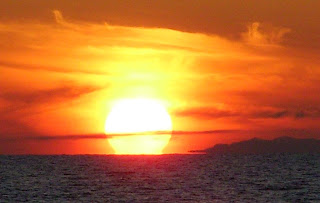
There was surprisingly little shipping in the Sardinia Sea although that which we encountered was remarkable. We were called on the VHF Radio from a ‘Coalition Ship’ that we had seen on Radar some twelve miles away. The polite female American radio operator requested that we alter course to starboard and pass astern of her to avoid any risk of collision. Somewhat cautious, we thought, but we complied, as we were ‘give way’ vessel. As it passed we identified the vessel as a huge US Navy aircraft carrier. I guess there was some security reason for their request and that collision avoidance was a secondary or fictitious premise. This is the first time in thirty years that I have been hailed by a vessel other than a yacht belonging to a friend.
As dawn rose at 0530 and later at sunrise what I mistook for clouds were actually the limestone cliffs along the coastline of Sardinia on the horizon. After a further six hours from that first sighting forty miles offshore we dropped anchor in Cala Del Bollo in Porto Conte on the approaches to Alghero where the water was so clear you could see the anchor dug in. We have never seen water so crystal clear.
The weather was settled and we motored in calm conditions towards the Fornelli passage, a narrow shallow bit of water separating Sardinia mainland from Isola Asinara, a former quarantine island and penal colony and now a nature reserve. The passage was easy to navigate by following transits although seeing the rock beneath one as close as 3 metres is disconcerting. Past this passage a light sea breeze developed along the north coast of Sardinia that allowed us to fly our colourful cruising chute all the way to our destination for the night, Castelsardo. The Ormeggiatori, a wonderful word for chaps from the marina who help one tie up, were friendly and we were surprised at the lack of formality. Unlike Spain and Portugal we did not have to show passports or, in fact, papers of any kind, we just paid 38 euros for two nights. A bargain we thought.
We climbed the mountain into town and, after much searching, found everything that we were looking for: a phone shop for an Italian SIM carte, the supermarket with the best view in the world, a good chandlery, a brilliant fruit and vegetable store and a post office where waiting was included in the price.
It was from Castlesardo that we set off for Corsica. Incredible though it may seem we were hailed on the VHF radio by yet another warship. This time it was a Spanish fleet auxiliary carrying out ‘special operations’. He was extremely courteous and, of course, we gave way to him.
Our return from Corsica took us directly to the Maddalena Archipelago on the northeastern tip of Sardinia, an area that we were looking forward to visiting for its unspoiled, albeit barren, landscape and idyllic anchorages. Miggy sailed in these Islands some seventeen years ago. Our anchorage at Passo Secca di Morto, or Deadman’s Reef Passage was indeed spectacular with crystal clear turquoise water, white sand beaches and wild flowers in abundance. Our peace and solitude was broken by the first boatload of trippers swarming onto the tiny beaches armed with swimming gear, kitchen sink and their sarnies wrapped in paper that they will leave behind them on the shores or hidden in the undergrowth of this beautiful nature reserve. Whilst on this subject the rules of the Reserve are not being obeyed by private yachts or tripper boats who are all transiting or anchoring where they should not destroying the very flora and fauna that the rules are there to protect. No one is policing this place and it will be lost forever before too long.
Our solitude and peace was restored in the late afternoon when the Italians return home for their all important evening meal.
After only a few days at anchor the wind put paid to our plans and we were forced to make for the shelter of the Marina at La Maddalena town. It is a well known fact in sailing circles that yachties go mad if they are sat in port for too long with too much wind. No wonder they call these Islands the Maddalenas. The Maestrale wind, or French Mistral, appears to last for multiples of three days up to nine days at the most. In layman’s terms air from a depression over France is squeezed between the Pyrenees and the Alps and so accelerates to blow strongly from the west or northwest over the western Mediterranean. The three mile wide Straights of Bonifacio between high ground either side, infamous for strong winds, accelerates the flow of this pressure wind further. They say that you can add two Beaufort forces in the ‘Bocche’ to the force of the pressure wind outside.
The digital recorder given to us as a present by John and Karin Spink is invaluable for forecasts, which can be played back slowly to decipher. Actually we are getting proficient at understanding the Italian forecasts even those given in Italian. They have a continuous computerised forecast given in Italian and English that keeps us informed as long as it is reasonably accurate. Navtex is hopeless in that as soon as there is a hint of bad weather Rome and La Garde, France, give up!
The small town of La Maddalena is very pleasant. The Church museum has the magnificent cross and candle holders that Nelson gave to the Church after his stay here on the ‘Victory’ in 1804. A The letter in his own hand accompanying the gift reads:
Rev, Sir
I have to request that I may be allowed to present to the church at La Maddalena a gift for the church as a small token of my esteem for the worthy inhabitants, and my remembrance of the inhabitant’s treatment of His Majesty’s fleet under my command that has been received from them. May God bless us all.
I remain Rev, Sir
Your most obedient servant
Nelson Bronte
The British fleet was here in 1803 – 1805 to keep a close eye on the French fleet anchored in the Port of Toulon. Lord Nelson did not step ashore on the Islands as he felt he would be betraying treaties made with Italy. He was also a very private man who rarely left the comforts of his ship. He did however establish a good relationship with the Commander of the Port of La Maddalena who spent many nights being entertained by Nelson aboard ‘Victory’ Lord Nelson asked his Anglican Chaplain, Father Scott Alexander, to deliver the gift. The priest at Maddalena church wrote saying that a mass of thanksgiving was celebrated for the gift to the church and that the last hymn sung therein was the Te Deum in honour of Lord Horatio Nelson.
Nelson felt it strategically important that the British Fleet have a base in the Maddalenas but he died before he could so persuade the Admiralty. His wise counsel was not in vain, however, the Americans having taken heed and established a Naval Base here a century and a half or so later.
We could do with the support of Nelson and his fleet, as we are one of only three British yachts we have come across in Sardinia amongst a multitude of French and Italians with quite a few Germans as well.
Miggy had her haircut in the town at the enormous expense of 37 euros (£26). There was no styling, special treatments or the like just the removal of a massive amount of hair. I guess they charge according to the amount they cut off.
The effects of the strong winds on the axis of the Bocche di Bonifacio are not generally felt further south so we made passage southward.
We chose to sail on past the Aga Khan’s creation Porto Cervo and the Costa Smeralda, the playground of the mega rich. It is not only because he cost of a night’s stay in Porto Cervo for us would have been around 200 euros (£140) but also because there was little room for we little yachties in the bays and ports crowded with the motor cruisers, the size of which can only classify them as Cruise Liners.
We threaded the narrow Passo del Galere between Isola Nibani and the Sardinian mainland and sailed on amidst stunning scenery down to the daunting Capo Figari across the Golfo di Olbia to the idyllic and peaceful anchorage of Porto della Taverna in the lee of the massive granite chunk of Isola Tavolara.
Pausanias wrote of the eastern coast of Sardinia some 2000 years ago “…An unbroken chain of impassable mountains, and if you sail along the coast you find no anchorage…while violent but irregular gusts of wind sweep down to the sea from the tops of the mountains.” (Thanks to Rod Heikell for the quote from his ‘Italian Waters Pilot‘) This is an apt description of this magnificent coast to this day and one has to be aware of the katabatic winds to which he refers.
Harbours and anchorages south of Olbia are few and far between until one reaches the southeastern tip of the Island and those that we have visited; La Caletta and Santa Maria Navarrese are resort towns of little interest or charm. The scenery is wonderful however and the marinas provide a safe haven for a night or two. Cagliari has all the facilities and services one would expect of a capital city and it has a delightful old quarter with narrow streets lined with fine shuttered houses.
Marinas in Sardinia have been reasonably priced at around 25 euros (£18) per night but in ‘mid season’. They are more expensive as from the 1st July as it is ‘high Season’ and at Santa Maria Navarrese we paid 44 euros (£30). There are those more expensive and a few a little cheaper. In nature Reserves such as the Maddalenas there is a charge of about 20 euros (£14) for anchoring or picking up one of their buoys if laid that is if, in the unlikely event, they are around to charge you!
A mention of a new find ‘Pane Carasau Mezza Luna’. It is thin crunchy bread wafer that is a great snack or a less fattening substitute for real bread with a meal. On the topic of food and incidentally nice Frenchmen a number of French yachts arrived in Porto Corallo having sailed from Tunisia overnight. Between them they had caught 50 Kilos of Tuna, the largest single fish being 15 Kilos. They gutted the fish on the dock and in return for lending them a sharp stainless steel chopper and a load of encouragement they kindly gave us two Tuna steaks and a Kilogram fillet. The steaks were so fresh and therefore so tasty when we eat them that night and the fillet was excellent in a Risotto a couple of days later.
Sardinia has a dry, barren landscape, which, on the east coast is painted a lot greener with Holm and Cork oak trees. There is little soil to support agriculture, although they produce some good red wines and cheeses. All in all Sardinia has not lived up to our expectations although the abnormally strong winds that we have had may have clouded our judgement somewhat. Our Pilot Book tells us that Sardinia has a 1% chance of gales in July. So far we have had gales for five days out of thirteen and even now in Cagliari a strong Sirocco, a moist southerly wind from the desert in North Africa, has set in.
It is very hot, hot enough for Miggy to swim in the sea at 23 deg at every opportunity and hot enough for us to come back to the temperate climes of England on the 19th July. Our phone number there is +44 7913847047.
Miggy will next ‘appear’ on BBC Radio Solent on the 9th of August. It will be exciting for us, as we have been invited for the entire Julian Clegg morning show from 0600 to 0930 or so.

Sunday, June 24, 2007

A Land of Mystery and Beauty

Imagine a land where the giant pines thrust up through the mist towards the snow capped peaks of the mountains above, where gushing torrents cut through lush valleys, where mysterious castles overlook white sand beaches and crystal clear turquoise water. That land is Corsica, a small French Island only seventy miles from Rome and very much Italian in flavour and culture.

We have explored the south of Corsica in Bella from the capital of the Island Ajaccio, the birthplace of Napoleon Bonaparte, on the west coast to Porto Vecchio, a Genovese walled Citadella on the east coast. In between we have anchored in beautiful bays where the water is so clear over the white sand seabed that one can see the anchor set five metres down and we visited the enchanting town of Bonifacio.

The entrance to Bonifacio from seaward is outstanding passing the narrow gap between high craggy white chalk cliffs with many caves and bizarre shapes that have been sculpted by wind and sea. Bonifacio town sits high on a spit of land separating the two mile long narrow fiord like inlet from the sea. It has been likened to a ship carved out of the rock. The massive Bastion de L’Etendard dominates the marina. A steep and exhausting, but ultimately rewarding, climb from the Marina and its waterside restaurants and bars leads to the medieval Haute Ville with its tall shuttered houses lining the narrow streets. Being on an outcrop of rock Bonifacio has enforced boundaries that obviate the urban sprawl that other towns have. It is so refreshing to see no industrial zone, no housing estate, and no shopping precinct.

At the tip of Bonifacio’s promontory past the Genovese towers of the early fortifications is the Bosco area. Here there is the Cemetiere Marin with its Family mortuary chapels where the bodies of those that pass away are incarcerated in tomb like slots and blocked in with an engraved slab. These can be seen all over the Island and appear at first sight from seaward to be villages.

We had an excellent supper at the restaurant in which Miggy and her ‘flotilla’ friends eat some seventeen years ago. At that time she had to have her prawns ‘pureed’ because she had fallen and damaged her mouth seriously. This time we had enormous tasty prawns with a mustardy mayonnaise preceded by a ‘marmite’ of various fish in a rich soup.

A wonderful day’s touring the parts of Corsica that we will not visit by sea made the exorbitant car hire price worth every euro. We actually drove for about ten hours north through the middle of the Island and back south down the west coast.

The mountains, the highest still snow capped, rise along the north south central spine of the island up to the 2700 metre peak of Monte Cinto. The foothills are covered with Maquis, Olive and Chestnut trees and the central zone of the island, except for the lush valley floors and areas destroyed by fire, is an immense forest of Conifers dominated by giant Laricio pines. There are also many Eucalyptus trees introduced in 1868 to drain the swamps and so help eradicate Malaria.

Corsica receives heavier rainfall than other Mediterranean Islands and so has torrents cutting gorges through the granite mountain slopes. Guy de Maupassant wrote, “Imagine a world still in the midst of chaos, a tempest of mountains separating narrow gorges in which torrents flow…. no plains, but rather immense waves of granite and colossal undulations or earth covered with Maquis or tall chestnut and pine forests”

There is an abundance of Flora with wild Roses, myrtle wild rosemary, wild fennel and broom whose colours paint the hillsides and whose essences fill the air. The mountains and hill have a truly ‘alpine’ feel. Animals roam freely along the roads. Pigs with their Piglets, cows and Goats caused us to stop on many occasion. Unfortunately we did not come across the wild boar, Corsican deer, moufflon or Hermann’s tortoise. Neither did we spot a golden eagle.

The west coast is most scenic with tall cliffs plunging into a crystal sea. Perhaps the most scenic of all is the coastline of the Scandola Nature reserve between Calvi and Ajaccio where the cliffs are red from ancient volcanic eruption as evidenced so well by the Calanques de Piana, granite rock formations weathered by wind and rain into extraordinary shapes which change from gold to pink and bright red depending on the time of day.

Of the wonderful bays in which we have anchored in Corsica, Golfe de Rondinara on the southeast coats will linger in our memories. Although crowded at lunchtime this turquoise water, white sand bay was left to a few other yachts, the cows and us by evening. It is where we departed Corsica to sail across the infamous Bouches de Bonifacio to the Madellena Archipelago off Sardinia, more of which next time together with our passage from Menorca to, and the northwest of, Sardinia, albeit out of date order.

Rondinara is also where we said fond farewells to our dear friends Renate and Hanspeter who we met in Rota last year and with whom we have ventured this far albeit not in company but rather crossing paths from time to time. They are travelling north to the French mainland via Elbe to take their yacht ‘Flamingo’ through the canals and ultimately to Holland to sell having been travelling round the world for the last fifteen years or so. We do hope to visit them in Switzerland in the not too far distant future.

We were surprised that Marinas and anchorages were not more crowded but then, of course, it is not yet the high season of July and August when the mainland French invade on mass. The mid season price of the Marinas was reasonable at around 28 euros per night in Ajaccio, Bonifaccio and Porto Vecchio. The anchorages are free. The cost of food, drink and the like in Corsica is expensive, however, being on a par with that in the UK.

We will be travelling back to the UK mid July with the intention of staying until the end of August in order to miss the heat and the silly season as regards pricey and crowded Marinas and anchorages and charter yacht antics. We look forward to seeing family and friends again during that time.

We are on our Italian number:
0039 338 233 8147

Wednesday, May 30, 2007

The Windy Island

Menorca, the small island of the Roman ‘Insulae Baleares’, lives up to its name as the Windy Island. Since we arrived at the Island on the 16th of May the surplus of the stuff and the swell created by its puff has curtailed our exploration of the place to some extent by sea although we have experienced a sample of the towns, one by bus, and the secluded anchorages.

Interestingly the French word used in weather forecasts for a blow or puff of wind is souffle – nothing to do with soufflé they say!

Another factor that put us off sailing to Ciudadela at the western end of the Island was the forecast of a phenomenon known as the resaca or seiche whereby in certain meteorological conditions the sea level rises and falls by as much as 1.5 metres every ten minutes or so, an oscillation that can continue for several days and make it uncomfortable if not dangerous in the town’s harbour and nearby anchorages. This phenomenon, that nobody appears to be able explain can be experienced along the south coast of the Island and as far away as Palma, Mallorca.

At the entrance to Mahon or, more correctly, Mao harbour we passed La Punta S’Espero, the most easterly point in Spain. The harbour at 5 kilometres long by 900 metres wide is the world’s second largest natural harbour some say, Sydney being the largest. Have they not heard of Poole harbour? It is a very large and sheltered harbour whatever and, bearing in mind its strategic position in the western Mediterranean, it is no wonder that it was fought over by the European powers during the 18th century, the British occupying the Island from 1708 to 1802 with very short interruptions from France and Spain. High on the cliff between Mao and En Castell, the most easterly town in Spain, stands the Georgian villa once the home of Admiral Collingwood, Nelson’s second in command, and on the north cliff across the harbour the beautiful Hacienda San Antoni where Nelson once stayed in 1799. Three Islands are situated in the harbour. The British built a hospital on the Illa de Rey that then became known as Bloody Island and the other two, Illa Plana and Illa Lazareto were used by them as quarantine Islands. Sailing further up the harbour the city of Mao appears as a jumble of attractive whitewashed houses perching atop the sheer cliff faces that grow directly from the deep clear water of the harbour.

Mao has a British feel reflecting its former government. It still retains some very English elements: sash windows, green shutters and brass doorknockers among them. There is even a Gin distillery here to this very day. The National Geographical Magazine’s description of the Menorcan capital in 1928 as ‘a maze of blinking alleyways leading up and down hill, lined with bright dolls’ houses’ still holds true. It is an enchanting place.

Mao has two major churches. In the Esglesia de Santa Maria music from the mighty 3,210 piped Swiss organ echoed around the dark foreboding edifice. Meanwhile in the Esglesia del Carme the tender strains of Mozart filled the bright yet austere interior. In stark contrast the Beatles were being piped throughout the latter church’s cloisters now gainfully used as the town market.
We moored stern to the harbour Authority’s floating pontoon ‘Isla Clementina’ overlooking the old town. From her we can take the dinghy the short ride to town. ‘Isla Clementina’ has the usual water and electricity on tap but also the luxury of a swimming pool, gardens and a shower! The Port Authority chap comes from Barcelona but its OK his name is Alfonso, not Manuel!

We took a bus through the centre of the Island with its dry stone walled fields alive with the colour of wild flowers and stocked with Frisian cows imported by the British in the 18th century. The terrain is undulating but the hills are low, the highest being Monte Toro in the centre of the Island at 357 metres. Our destination, Ciudadela, was the capital of the Island before the British moved the seat of government to Mao in 1722 because of the superior harbour there. Ciudadela may have lost its power but it retains fine Catalan and Italian styled 16th and 17th century palazzi with their richly adorned facades and an impressive Cathedral with brightly coloured stained glass windows all set in narrow arcaded streets and shady squares. This city of only 21,000 population abuts a small but picturesque harbour.

Fornells pronounced ‘Fornays’ is a village of whitewashed houses with 498 inhabitants on the shores of the lovely Cala of the same name on the north coast of the Island. The village is famous for its Spiny Lobster for which Juan Carlos, the King of Spain, regularly sails here from Mallorca to savour. The surroundings to the Cala are of unspoilt natural beauty.

It has suddenly struck me why Menorca seems so much different to the Spanish mainland and to some extent Mallorca and that is the fact that there was only one crane on the skyline of Fornells! Indeed now that I look I can only see two in Mao.

We have anchored in some deserted and unspoilt Calas in sparkling clear water over white sand surrounded by wild flower and tree clad rocky shores. We were fortunate to have this seclusion as in the season we gather that these beautiful inlets are crowded to overfilling with boats and holidaymakers on the beaches.

We are at this moment waiting in Mao in gale force winds for an opportunity to sail the 200 miles to Sardinia. Not far to the north of us along the French coast and in Corsica and Sardinia itself it is blowing storm force 10 with 6 metre waves. We reckon, having looked at various Internet forecasts, that we will not have more conducive weather for the crossing until later on this week. Never mind this is not a bad place in which to be stormbound.

Ciao. A piu tardi